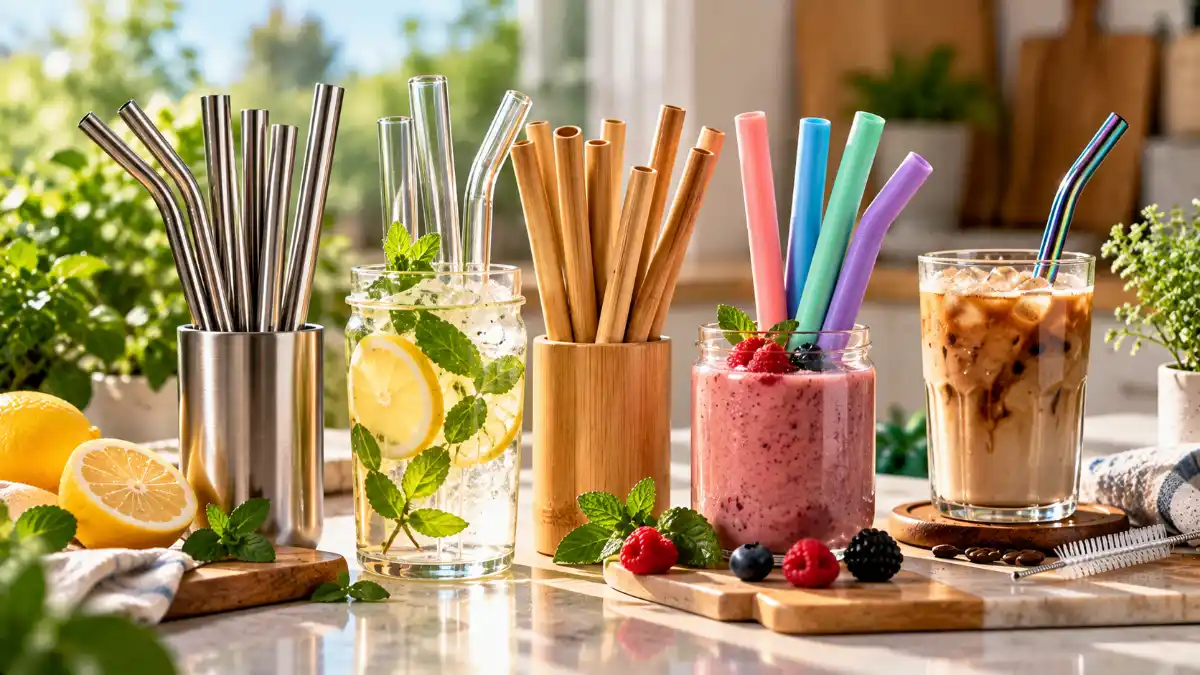
Reusable straw: What is appropriate, and what materials are used? Most reusable straws are made of stainless steel, silicone, borosilicate glass, bamboo, and/or titanium, or a blended plastic composite. They all do the same thing, but they feel and perform differently.
Silicone is soft and supple, whereas stainless steel is hard … and a stiff material. Suggested product direr are previews into clean, and bamboo Minnesota made. It looks nice.
To some extent, therefore, Assertion in reusable straws is a little more than simply deciding Metal Vs Factors product specifications (Diameter / Duration βαθμός και καθαριότητα, Maximum beverage temperature tolerance, επιχειρηματική προδιαγραφή).
If you’ve heard all the talk about reusable straws but aren’t up to date on what each one’s use is and how they actually stack up against one another in terms of materials (bamboo vs steel) and what’s optimal for drinks, plus what U.S. buyers should look out for, as well as when a straw must be changed, this guide does it all!
Quick Answer: A reusable straw is typically made from stainless steel, silicone, borosilicate glass, bamboo, titanium, reusable plastic, or a combination of these materials. The right choice depends on the drink, straw diameter, flexibility, cleaning requirements, durability, and how the straw will be used.
| Material | Basic composition | Main advantage | Main consideration |
| Stainless steel | Iron-based alloy containing chromium | Very durable | Rigid |
| Silicone | Silicone polymer/elastomer | Soft and flexible | Quality varies |
| Glass | Usually borosilicate glass | Interior is visible | Can break |
| Bamboo | Natural bamboo | Natural material | Needs thorough drying |
| Titanium | Titanium metal/alloy | Lightweight and durable | Higher price |
| Reusable plastic | Food-contact polymer | Lightweight | Can scratch or deform |
| Hybrid | Two or more materials | Combines useful properties | More parts to clean |
What Is a Reusable Straw Made Of?
There are many reusable straws as well,l since they can be made from different materials to combine all the needed characteristics. Some, ruggedness; some, versatility or visibility of weight; organic handfeel.
Who knew you were such an expert, right? With the materials identification, you can now conveniently compare products.
Stainless Steel Reusable Straws
Stainless steel is an iron alloy that has chromium within it, and this gives the stainless of quality, identified with anti-corrosive properties. Product descriptions often make claims like grade 304 or even 316, but you need to verify this by eagle-eyeing specifications from the manufacturer,r as not all metal straws available in the market would necessarily be of the same grade.
The biggest advantage is durability. Stainless steel straw: For none, in any case, with ordinary transport (in a lunch container, backpack,k or travel mug), isn’t inherently less breakable than glass.
Its main limitation is rigidity. The straw in ice water (or hot water) will be colder than this, and it’s also going to become comparably warm as if metal were eating it, because, again, the reason it is good at conducting temperature.
And it works well for that person who brings iced coffee to work every morning: stainless steel is sturdy, reusable, and easy to clean.
Inspect both ends periodically. But if the rim is all twisted or grooved, then just toss the straw.
- Read more: What Is a Reusable Straw Made Of
Silicone Reusable Straws
Silicone straws are made from a silicone-based polymer or elastomer. They are soft, bendable, and very different in feel from rigid stainless steel or glass.
Their flexibility makes them convenient for travel, collapsible drinking sets, and situations where a softer mouthfeel is preferred.
Quality can vary among products, though. Silicone formulation, thickness, finish, and manufacturing standards are not identical across brands. Some products can also hold odors after repeated exposure to strongly flavored beverages.
Cleaning the full interior is therefore important.
When using silicone with hot beverages or placing it in a dishwasher, follow the manufacturer’s temperature and washing instructions rather than assuming every silicone product has the same limits.
Borosilicate Glass Straws
Many reusable glass straws are made from borosilicate glass, a type of glass known for relatively low thermal expansion compared with common soda-lime glass. Borosilicate formulations vary, so the manufacturer’s specifications still matter.
Glass offers one unusually useful feature: transparency.
You can look through the straw and see whether smoothie, juice, or other residue remains inside after cleaning. Its smooth surface also makes it attractive to people who want a neutral drinking experience.
The obvious drawback is breakage.
A glass straw should be inspected before use. If you notice a crack, chip, or damaged edge, stop using it rather than trying to extend its lifespan.
Bamboo Reusable Straws
Bamboo straws are made from sections of natural bamboo rather than molded plastic or metal. Their exact appearance and internal diameter may vary because they originate from a naturally grown material.
They are lightweight and appeal to people who prefer naturally derived products, but they generally require more maintenance.
Moisture is particularly important. A bamboo straw should be washed appropriately and allowed to dry completely before being placed in a case or drawer.
Think of it somewhat like a wooden kitchen utensil: leaving it damp for long periods is less desirable than doing the same with stainless steel.
Check bamboo regularly for cracking, splitting, persistent odors, discoloration, or mold. A damaged or moldy straw should be replaced.
Titanium Reusable Straws
Titanium is a less common premium reusable straw material.
It is valued for its combination of low weight, durability, and corrosion resistance, making it attractive for camping equipment, travel kits, and buyers who want a lightweight metal straw.
Its biggest disadvantage is usually cost. Stainless steel offers many of the practical benefits most everyday users need at a lower price, so titanium tends to appeal more to buyers who specifically value its weight or material properties.
Reusable Plastic Straws
Not every plastic straw is disposable. Reusable versions may be made from polymers such as polypropylene (PP), polyethylene (PE), or other materials specified by the manufacturer for the intended use.
Plastic has some practical advantages. It is light, inexpensive, and less likely to shatter than glass.
However, reusable plastic can become scratched, cloudy, cracked, or deformed over time. Temperature compatibility also depends on the particular polymer and product design.
A “BPA-free” label should not be treated as a complete description of a product’s safety or composition. It addresses one particular chemical concern; it does not tell you everything about the polymer, additives, manufacturing quality, or intended conditions of use.
Hybrid Reusable Straws
Hybrid designs combine two or more materials.
Common examples include:
- stainless steel with a silicone mouthpiece;
- collapsible silicone stored inside a metal case;
- a rigid straw body with a removable soft tip.
These designs can combine metal durability with a softer mouthfeel or make a straw easier to carry.
The trade-off is additional components. Removable tips, joints, telescoping sections, and cases all need appropriate cleaning and inspection.
Reusable Straw Materials Compared
A quick comparison can make the differences easier to understand.
| Material | Flexibility | Durability | Breakage concern | Cleaning | Travel use | Main drawback |
| Stainless steel | Low | High | Low | Easy | Excellent | Rigid |
| Silicone | High | Good | Very low | Moderate | Excellent | May retain odors |
| Glass | Low | Good when protected | Higher | Easy | Moderate | Can chip or break |
| Bamboo | Low | Moderate | Can split | More care | Good | Must dry thoroughly |
| Titanium | Low | Very high | Low | Easy | Excellent | Price |
| Reusable plastic | Varies | Varies | Low | Easy | Excellent | Scratching and wear |
There is no useful universal claim such as “a reusable straw lasts exactly five years.” Lifespan depends on product quality, frequency of use, washing, impacts, storage conditions, and manufacturer specifications.
What Does “Food-Grade” Mean for a Reusable Straw?
“Food-grade” is useful shorthand, but consumers should not rely on the phrase alone.
Material Name Alone Does Not Tell the Whole Story
Seeing “silicone,” “plastic,” or “stainless steel” on a package does not describe every component or condition under which a finished product should be used.
For U.S. food-contact materials, FDA explains that regulatory status depends on the individual substances composing a material and their authorized intended uses. Specifications and limitations on conditions of use also matter.
That means shoppers should look beyond broad marketing terms.
Useful information includes:
- exact material identification;
- manufacturer information;
- intended food or beverage use;
- temperature limitations;
- cleaning instructions;
- dimensions and construction;
- credible food-contact documentation where applicable.
Why Conditions of Use Matter
The same material should not automatically be assumed suitable for every temperature or application.
FDA’s food-contact framework distinguishes multiple food types and conditions of use, including refrigerated, room-temperature, hot-filled, boiling-water, and higher-temperature applications.
In practical terms, a straw advertised only for cold beverages should not automatically be used with very hot liquid. Follow the finished product’s instructions.
What U.S. Buyers Should Check Before Purchasing
Before buying, check:
- Exact material is clearly identified
- Manufacturer or brand is identifiable
- Intended food/beverage use is stated
- Temperature guidance is available
- Dishwasher or hand-washing directions are provided
- Length and diameter are listed
- Rim appears smooth and properly finished
- Cleaning brush fits the straw
- Damage or replacement guidance is available
- Claims are supported by meaningful specifications rather than vague words such as “premium” or “eco-friendly”
Which Reusable Straw Material Is Safest?
There is no single material that is automatically safest for every person and every situation.
Chemical Safety and Physical Safety Are Different
A useful distinction is material/chemical suitability versus physical safety.
Stainless steel can be durable and corrosion-resistant while still being rigid. Glass can offer a smooth, transparent surface while remaining breakable. Silicone is soft and flexible but must still be cleaned thoroughly. Bamboo is natural but needs proper moisture management.
So a product should not be judged on one property alone.
Reusable Straws for Children
Rigid straws require particular care around young children.
A study of U.S. emergency-department data from 2012 through 2021 found straw-related injuries were disproportionately common among children ages three and younger; poking injuries were the most common mechanism, and reusable straw materials were associated with more laceration and oral injuries.
For children, consider the manufacturer’s age guidance, supervision, flexibility, and how the straw will be used. Avoid walking or running with a rigid straw in the mouth.
Metal and Glass Straw Safety
For rigid straws:
- avoid walking or running while drinking;
- never use cracked or chipped glass;
- inspect metal rims for damage;
- use extra care when a rigid straw projects from an open cup;
- consider a soft mouthpiece where appropriate.
These precautions address physical injury risk rather than implying there is something inherently unsafe about using a properly manufactured rigid straw normally.
Which Reusable Straw Is Best for Different Drinks?
The “best” reusable straw often depends more on diameter and length than people expect.
| Drink | What matters | Useful straw characteristic |
| Water | Convenience | Standard diameter |
| Soda | Easy flow | Standard diameter |
| Iced coffee | Cup height | Standard or long straw |
| Smoothie | Thick texture | Wide diameter |
| Milkshake | High thickness | Extra-wide straw |
| Juice | Normal flow | Standard diameter |
| Boba | Tapioca pearls | Extra-wide boba straw |
| Hot beverage | Temperature suitability | Manufacturer-rated product |
Why Straw Diameter Matters
A narrow stainless-steel straw may be excellent for water but frustrating with a thick smoothie.
As beverage thickness increases, a wider internal opening generally makes drinking easier.
A useful mental scale is:
Narrow → Standard → Wide → Extra Wide/Boba
For drinks containing large tapioca pearls or chunky ingredients, check the actual internal diameter before purchasing.
Why Straw Length Matters
A perfect material is not useful if the straw disappears into your tumbler or sticks awkwardly far above a small glass.
Before buying, consider the cups you use most often:
- cans;
- drinking glasses;
- mason jars;
- travel tumblers;
- tall insulated cups.
Measure your frequently used cup if the listing offers multiple straw lengths.
How to Choose a Reusable Straw in 6 Steps
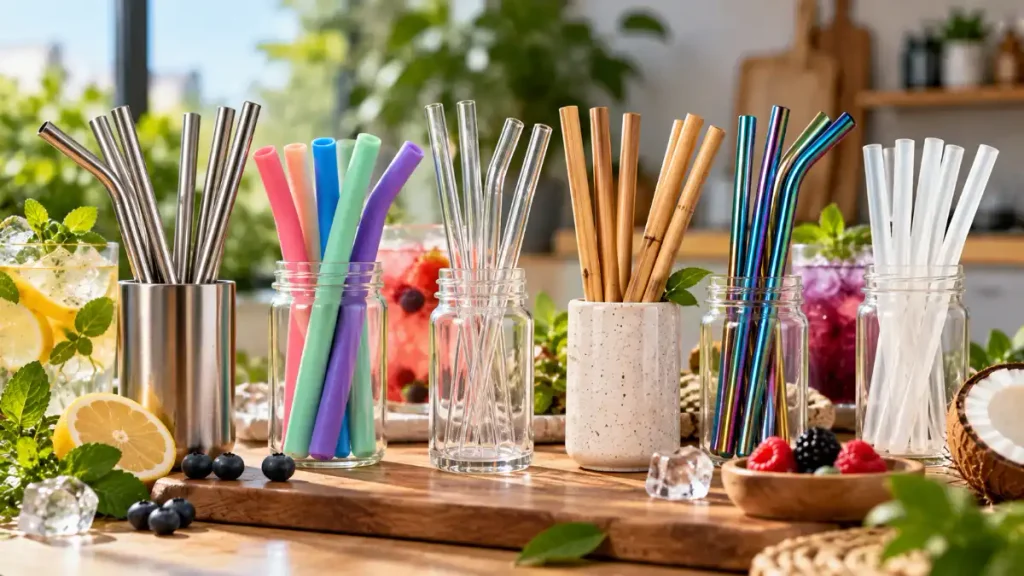
Step 1 — Choose the Material
Start with your priorities.
Choose between flexibility, durability, visibility, natural construction, low weight, and ease of maintenance.
Step 2 — Select the Correct Diameter
Match the opening to the drink:
- water and soda: standard;
- smoothies: wide;
- milkshakes: wide or extra-wide;
- boba: extra-wide.
Step 3 — Measure the Length You Need
Measure the cup or tumbler you use most often rather than choosing based only on product photos.
Step 4 — Check Temperature Compatibility
If you plan to use the straw with hot liquids, confirm that the manufacturer specifies the product for that use.
Step 5 — Consider Cleaning
Ask four questions:
- Does the included brush reach all the way through?
- Can you inspect the interior?
- Is the product dishwasher-compatible?
- Can it dry fully before storage?
Step 6 — Examine Product Information
Terms such as natural, premium, BPA-free, eco-friendly, and food-grade can be helpful, but they should not replace real specifications.
Look for material details, dimensions, use limits, washing instructions, and a recognizable manufacturer.
Quick Reusable Straw Buying Checklist
Before placing an order, confirm:
- material;
- diameter;
- length;
- flexibility;
- intended beverage temperature;
- cleaning method;
- smooth rim or mouthpiece;
- storage requirements;
- replacement guidance;
- manufacturer information.
A straw that suits your actual routine is more useful than one chosen only because its material sounds environmentally friendly.
How to Clean a Reusable Straw Properly
Reusable products only remain practical when they can be cleaned consistently.
Everyday Cleaning Method
A simple routine works for many products:
- Rinse soon after finishing the drink.
- Use warm water and dish soap as appropriate for the product.
- Push a correctly sized straw brush through the entire internal channel.
- Rinse thoroughly.
- Inspect both ends and the interior where possible.
- Let the straw dry completely.
- Store it only after it is dry.
Always follow manufacturer-specific washing directions.
Cleaning After Smoothies, Milkshakes, or Dairy Drinks
Thick beverages can leave more residue than water or soda.
The easiest habit is to rinse the straw immediately, before smoothie or milkshake residue dries inside.
A wider cleaning brush matched to the internal diameter can also make the process easier.
Dishwasher vs Hand Washing
Do not assume every product within a material category is dishwasher-safe.
Two silicone, plastic, bamboo, or glass straws from different manufacturers may have different instructions.
Check the product guidance first.
How to Dry and Store Reusable Straws
Airflow matters.
Let washed straws dry fully before placing them inside an enclosed travel case. This is especially important for bamboo and other materials that should not remain damp.
A travel case is useful only when the straw going into it is clean and dry.
When Should You Replace a Reusable Straw?
Replacement is usually better based on condition than an arbitrary calendar date.
| Material | Inspect for | Replace when |
| Stainless steel | Damaged rim, severe dents, corrosion | Edge or structure is compromised |
| Silicone | Tears, tackiness, deterioration | Material becomes damaged |
| Glass | Chips or cracks | Any visible structural damage |
| Bamboo | Mold, cracks, splitting | Mold or deterioration develops |
| Titanium | Damaged edges or structural damage | Integrity is compromised |
| Plastic | Deep scratches, cracks, deformation | Significant wear develops |
Regular inspection is more useful than assuming every straw made from a certain material has the same lifespan.
Are Reusable Straws Better for the Environment?
A reusable straw can reduce reliance on disposable straws, but the environmental picture is more complicated than “reusable equals zero impact.”
Reusable Does Not Automatically Mean Low Impact
Environmental impact can involve:
- raw-material extraction;
- manufacturing;
- transportation;
- repeated washing;
- product lifespan;
- disposal;
- local recycling infrastructure.
A heavier, resource-intensive product that is barely used may not deliver the same benefit as one that becomes part of a person’s daily routine.
Why Number of Reuses Matters
The practical advantage of a reusable product increases when it is actually reused repeatedly instead of continually replaced.
That is why exact claims such as “material X becomes greener after exactly Y uses” should be treated cautiously unless they come from a lifecycle analysis with clearly defined assumptions.
If you already own a functional reusable straw, continuing to use and maintain it may be more sensible than repeatedly replacing it just to switch materials.
Reusable vs Recyclable vs Biodegradable
These terms describe different things:
Reusable means a product is designed for repeated use.
Recyclable means a material may be processable into another product where suitable collection and recycling infrastructure exists.
Biodegradable means a material can break down biologically under particular conditions.
A product can possess one characteristic without possessing the others.
What Actually Matters Beyond the Material
Material gets most of the attention, but it is only part of the product.
Two Straws Made From the Same Material Can Perform Differently
Two stainless-steel straws can differ in:
- wall thickness;
- internal diameter;
- length;
- edge finishing;
- manufacturing quality;
- surface finish.
The same is true for silicone, glass, bamboo, and plastic products.
The label alone does not tell you the complete user experience.
Diameter Can Matter More Than Material for Thick Drinks
Imagine buying a premium stainless-steel straw for a morning smoothie only to discover that the opening is too narrow.
The steel itself is not the problem. The dimensions are.
For smoothies, milkshakes, and boba, check width before focusing on smaller differences between materials.
Softness and Rigidity Are Separate From Composition
Stainless steel can be durable but rigid.
Silicone can be flexible but requires different cleaning considerations.
Glass can be easy to inspect but breakable.
Bamboo can feel natural but requires more careful drying.
Instead of asking which material is universally “best,” ask which combination of properties suits the intended user.
Use the Look → Feel → Smell → Clean Check
A simple inspection routine can catch many problems:
Look: Check for cracks, chips, mold, deformation, or unusual discoloration.
Feel: Check the rim for roughness, sharp spots, tackiness, or deterioration.
Smell: Notice persistent unusual odors after cleaning.
Clean: Make sure the entire internal channel can be cleaned and is free of residue.
Common Mistakes When Buying or Using Reusable Straws
Avoid these common errors:
- Choosing a diameter that is too narrow for the drink.
- Ignoring the height of your usual cup.
- Assuming every product made from the same material has identical quality.
- Continuing to use chipped or cracked glass.
- Storing bamboo before it is fully dry.
- Cleaning only the outside instead of the internal channel.
- Buying solely because packaging says “eco-friendly.”
- Assuming “BPA-free” describes the entire product formulation.
- Ignoring manufacturer temperature limits.
- Choosing a rigid straw without considering the user and situation.
Which Reusable Straw Material Should You Choose?
There is no universal winner, but this quick matrix can narrow the options.
| Your priority | Material/type to consider |
| High durability | Stainless steel or titanium |
| Flexibility | Silicone |
| Visible cleanliness | Glass |
| Naturally derived material | Bamboo |
| Lightweight travel | Silicone or lightweight metal |
| Thick smoothies | Wide steel, silicone, or glass |
| Boba | Extra-wide straw |
| Avoiding breakage | Silicone or metal |
| Straightforward maintenance | Steel or glass |
| Soft mouthfeel | Silicone |
The best approach is to evaluate material + diameter + use + cleaning + condition together.
Frequently Asked Questions
What Is A Reusable Straw Made Of?
Aspire: Most reusable straws are made with stainless steel, silicone, borosilicate glass, bamboo, titanium, reusable plastic, or a combination of any of them. Stainless steel, silicone, and glass are the most recognizable options.
Metal reusable straws. What’re metal unlimited-universe packed straws Types of Metal How to clean free reusable unfriendlyBuilt -Best Metal Unproportioned Patterns FAQ: Whereby are unrefined practiced speed rebalanced raw material?
The raw materials for most reusable metal straws are made of stainless steel. Titanium is used on high-end or lightweight products. Remember, you are dealing with metals, and they have numerous grades and alloys, so be sure to see the material specification from the manufacturer.
What is formed by shaped, reusable straw: multipartite device in silicone
It consists of a silicone polymer, α elastomer, by means of which you can describe this flexible molded item as a flexible tube. To begin with, silicone itself is a type of plastic in terms of challenging its chemistry and physical properties as it behaves. But product formulation and manufacturing instructions still matter.
Reuse Straws: So What Are They?
Some are. Reusable plastic straws are made from polypropylene or polyethylene. If the product you’re searching for, they tend to be considerably lighter than glass and less likely to break, but they should also be replaced when dented, creased, or scratched through.
The Gap Of The Stainless Steel And Silicone Straws
Stainless steel is resistant and durable, and silicone is soft, flexible, and very easy to carry. One person may want the maximum rigidity and strength of steel, while another may prefer silicone for a softer mouth feel.
Home » Blog » Glass Reusable Straws: Are They Safe?
The vacuum-sealed glass straw, for example, is more effective when used correctly; it performs as designed, but be cautious because it isn’t plastic and could shatter! Once you notice a crack, chip, or dented rim: DO NOT use a straw.
Can bamboo straws grow mold?
Yes, bamboo can form mold in humid conditions and due to improper storage. Follow instructions to clean bamboo, air-dry completely, and do not use the straw if any signs of mould, cracking, or other deterioration are present.
Do not use reusable straws with hot drinks.
Yes,s in some cases, albeit the applicability depends on the raw material and end product. Work in stages. Always refer to the manufacturer’s temperature guide before inserting a straw in hot liquid. Clearly, temperature is one of the relevant conditions of use within the FDA’s food-contact context.
Now the question arises: how often do you need a reusable straw?
There is a lack of an average replacement frequency. Often check the products; replace them when cracks, chips, rotten edges appear, mold causes deformation, or there is too much degradation or other damage affecting normal use.
Easiest-to-clean reusable straw
Smooth stainless-steel and glass straws are generally easy to clean; you can see if there is any residue in the straw due to its transparency. But the diameter, curvature, brush access -and even manufacturer washing instructions – also matter just as much as the material.