
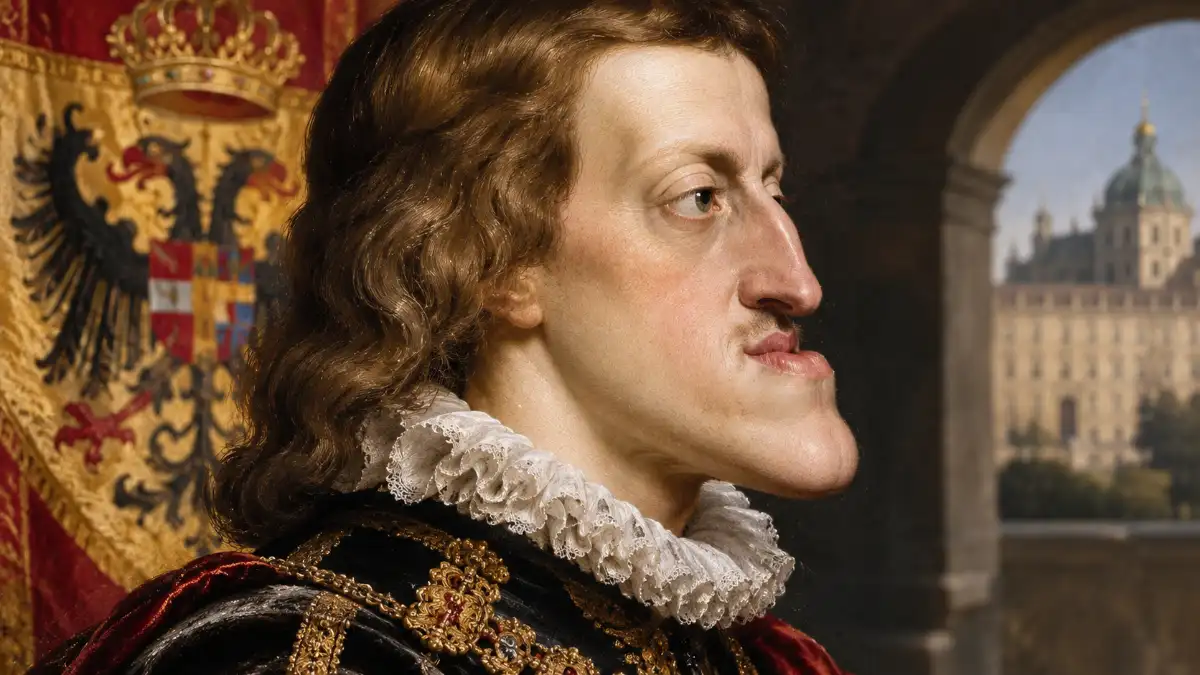
The Habsburg jaw is a historical name for the distinctive facial appearance seen in several members of Europe’s Habsburg royal dynasty. It is often described as a protruding lower jaw and prominent chin, but research suggests that a relatively small or retruded upper jaw was also important. Repeated marriages between close relatives may have helped those inherited traits persist. Studies support an association with inbreeding, although they cannot identify a single responsible gene or establish a medical diagnosis from paintings alone.
What Is the Habsburg Jaw?
The expression is a historical nickname, not a formal medical diagnosis. It commonly refers to a prominent lower face, projecting chin, pronounced lower lip, and an apparent underbite.
Two terms help explain the distinction. Mandibular prognathism means the lower jaw projects forward. Maxillary deficiency means the upper jaw is underdeveloped or positioned farther back. Either can make the chin look unusually prominent relative to the midface.
A 2014 study reexamining the Habsburg jaw assessed portraits of seven Spanish Habsburg rulers. Six were judged likely or very likely to show maxillary deficiency, whereas only three were judged likely to show mandibular prognathism. The authors suggested that upper-jaw deficiency, rather than excessive lower-jaw growth, could be the principal feature.
PubMed
Why Was This Facial Pattern Common in the Habsburg Family?
The House of Habsburg held power across much of Europe for centuries. Marriages helped its branches preserve dynastic claims, political alliances, and property. Some unions joined cousins; others involved uncles and nieces.
Because partners often shared ancestors, children could inherit the same genetic variants through both sides of the family. Repeated over generations, these relationships increased the chance that certain inherited traits appeared together.
Did Inbreeding Cause the Habsburg Jaw?
Inbreeding is the leading historical explanation, but the evidence supports an association rather than a conclusive diagnosis for each royal.
In 2019, researchers analyzed 66 portraits of 15 Habsburg family members. Ten maxillofacial surgeons evaluated 18 facial characteristics associated with mandibular prognathism and maxillary deficiency. Researchers compared those observations with inbreeding coefficients calculated from family trees.
The study found that the two facial patterns frequently occurred together. Greater pedigree-based inbreeding was significantly associated with greater mandibular prognathism, although the corresponding association for maxillary deficiency was not independently statistically significant in the same analysis.
The 2019 study in Annals of Human Biology interpreted the results as consistent with increased homozygosity influencing the characteristic appearance.
PubMed
What Does an Inbreeding Coefficient Mean?
An inbreeding coefficient estimates the probability that two copies of a gene inherited by a person trace back to the same ancestral copy.
A separate 2009 genealogical analysis traced more than 3,000 individuals across up to 16 generations. It estimated an inbreeding coefficient of 0.254 for Charles II of Spain, reflecting extensive shared ancestry. The PLOS ONE study of Spanish Habsburg marriages also emphasized that distant ancestral connections added to the effects of closer marriages.
PLOS One
A high coefficient can raise the likelihood of some recessive conditions, but it cannot, by itself, explain one person’s facial structure or confirm a particular disease.
Which Habsburg Royals Had the Famous Jaw?
Charles V, Holy Roman Emperor
Charles V, Holy Roman Emperor (1500–1558), who also ruled Spain as Charles I, is one of the most recognizable examples. His portraits often emphasize a projecting lower face. Nevertheless, the exact balance between upper- and lower-jaw anatomy cannot be measured reliably from artwork.
Philip IV of Spain
Philip IV of Spain (1605–1665) belonged to the Spanish Habsburg branch. His portraits are among the historical images examined or discussed in connection with the family’s recurring facial characteristics.
Charles II of Spain
Charles II of Spain (1661–1700) was the last Spanish Habsburg king. He died without surviving children, ending that royal line. His family tree is particularly well known for repeated close-relative marriages, and historical accounts describe significant health difficulties.
Researchers have proposed genetic explanations for some of those difficulties. However, specific retrospective diagnoses remain uncertain: neither his pedigree nor the appearance recorded in portraits proves exactly which disorders he had.
Is the Habsburg Jaw the Same as an Underbite?
Not exactly. An underbite describes a bite relationship in which lower front teeth sit ahead of upper front teeth. Class III malocclusion is a broader orthodontic classification that can involve dental position, jaw structure, or both.
Mandibular prognathism concerns the position or projection of the lower jaw, while maxillary deficiency concerns the upper jaw. Someone can have a prominent-looking chin because the lower jaw projects forward, the upper jaw sits back, or both occur together.
Does a Prominent Jaw Cause Health Problems?
Not necessarily. A prominent chin can be normal facial variation.
When jaw alignment affects function, possible problems include difficulty biting or chewing, uneven tooth contact, or speech difficulties. A dentist or orthodontist can assess the bite and decide whether imaging or specialist evaluation is appropriate.
The U.S. National Library of Medicine’s MedlinePlus explanation of prognathism also notes that some cases are inherited, while others may be associated with particular medical conditions. New or changing jaw prominence deserves medical assessment, especially when accompanied by other symptoms.
MedlinePlus
Can a Habsburg-Type Jaw Be Treated Today?
Yes, when a similar jaw pattern creates a clinical problem. The treatment depends on age, growth, tooth alignment, and whether the skeletal difference involves the upper jaw, lower jaw, or both.
For growing children, selected orthodontic or orthopedic treatments may help address developing bite relationships. Some adults can manage dental misalignment with braces or aligners. Major skeletal discrepancies may require orthognathic jaw surgery combined with orthodontic care.
An orthodontist can recommend options after evaluating function, anatomy, and individual goals.
What Can We Learn From the Habsburg Jaw?
The story connects royal history with genetics, but it also illustrates the limits of historical evidence. Portrait artists could flatter, stylize, or exaggerate their subjects. Researchers can compare visible characteristics and detailed family trees, but they cannot recover complete skeletal measurements or DNA evidence from painted images.
The most defensible conclusion is that close-relative marriages likely influenced the frequency and expression of some Habsburg facial traits.
Conclusion
The Habsburg jaw was a recurring royal facial pattern associated with lower-jaw projection, upper-jaw deficiency, or both. Research links its severity to shared ancestry, while leaving the precise genetic causes unresolved. For someone concerned about a similar jaw shape today, bite function and an individual clinical assessment matter much more than resemblance to a historical portrait.
- Read more: Habsburg Jaw
Frequently Asked Questions
What does Habsburg jaw mean?
It is an informal historical label for facial features seen in several Habsburg royals, especially a prominent lower face and an apparent underbite.
Was the Habsburg jaw genetic?
Genetics likely contributed. Researchers found links between family relatedness and facial traits, but no single causal gene has been confirmed for the dynasty.
Did inbreeding cause the Habsburg jaw?
Close-relative marriage probably contributed to the pattern. Portrait and pedigree studies support that connection but cannot establish a definitive cause for every individual.
Which royal is most associated with it?
Charles V and Charles II of Spain are prominent examples. Charles II is particularly famous because of his highly interconnected family tree.
Did every Habsburg have the same jaw?
No. The appearance varied among family members, and historical portraits cannot show whether each person had the same underlying skeletal condition.
Is the Habsburg jaw an underbite?
It can be associated with one, but the historical label also covers upper-jaw deficiency and lower-jaw projection, which are not identical diagnoses.
Can someone have this jaw without Habsburg ancestry?
Yes. Prominent jaws and Class III bite patterns occur in many unrelated families and do not establish royal ancestry.
Is mandibular prognathism always unhealthy?
No. It may be a normal anatomical variation. Assessment becomes important when jaw alignment affects chewing, speaking, or dental health.
Can a similar jaw shape be corrected?
Sometimes. Orthodontics may help align teeth, but significant skeletal differences may require specialist treatment, including jaw surgery.


