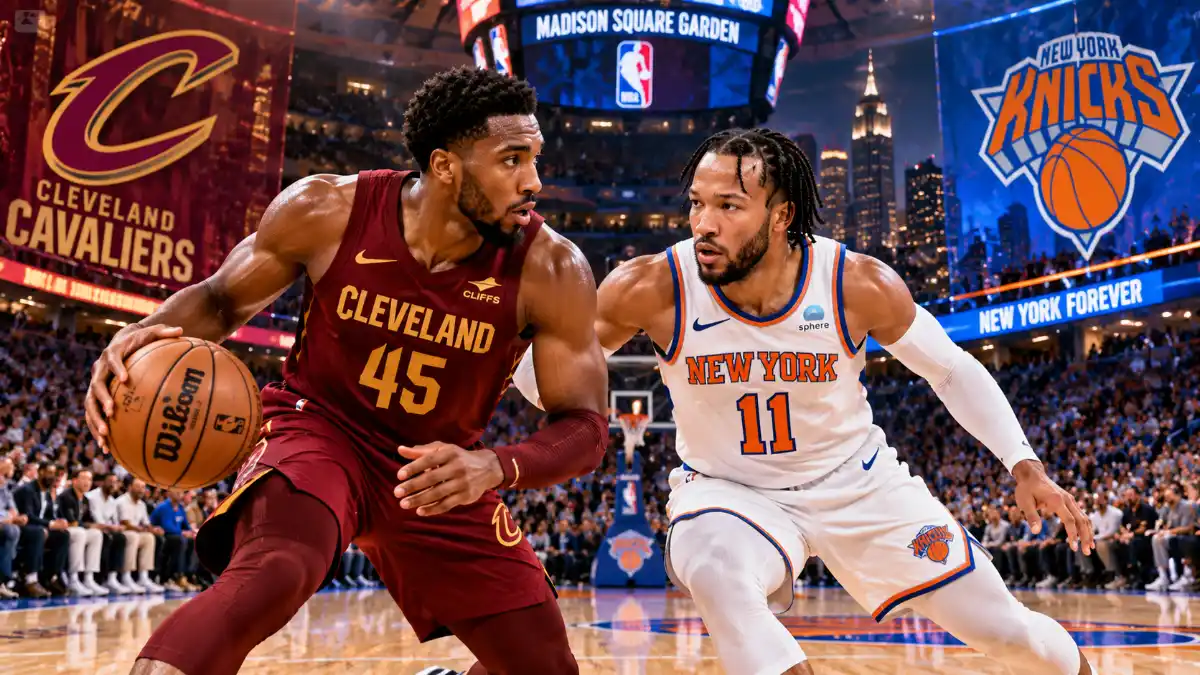
The Cavaliers vs Knicks matchup enters the 2026–27 NBA season with considerably more significance than an ordinary Eastern Conference regular-season series. New York is coming off an NBA championship, while Cleveland is trying to respond after the Knicks swept the Cavaliers in the 2026 Eastern Conference Finals.
That postseason result gives every new meeting an obvious storyline: can Cleveland find answers for a New York team that controlled their most important series of the previous season?
The teams are scheduled to meet four times during the 2026–27 regular season, including three meetings in November and a nationally distributed December rematch.
This guide covers the schedule, recent results, playoff background, and the basketball factors that could shape the next chapter.
Cavaliers vs Knicks 2026–27 Schedule
As of September 15, 2026, the NBA schedule lists four regular-season meetings.
| Date | Matchup | Venue | Scheduled Time |
| Nov. 7, 2026 | Knicks at Cavaliers | Rocket Arena | 8:00 p.m. ET |
| Nov. 11, 2026 | Cavaliers at Knicks | Madison Square Garden | 7:00 p.m. ET |
| Nov. 25, 2026 | Cavaliers at Knicks | Madison Square Garden | 7:30 p.m. ET |
| Dec. 21, 2026 | Knicks at Cavaliers | Rocket Arena | 7:00 p.m. ET |
The Nov. 25 meeting is listed as an Emirates NBA Cup East Group B game. The Dec. 21 contest is scheduled for Peacock/NBC Sports Network and has specifically been promoted by the NBA as a rematch of the 2026 Eastern Conference Finals.
Schedules and broadcast arrangements can change, so fans should verify the NBA’s official schedule near game day.
- Read more: Cavaliers vs Knicks
Why This Matchup Matters More in 2026–27
Context changed dramatically during the previous postseason.
Cleveland survived a seven-game Eastern Conference semifinal against Detroit in 2026. New York swept Philadelphia in its conference semifinal. That set up a Knicks-Cavaliers Eastern Conference Finals series with a trip to the NBA Finals at stake.
New York then won all four games.
The Knicks followed that sweep by defeating San Antonio 4–1 in the NBA Finals, capturing their first championship since 1973.
Consequently, Cleveland is no longer simply facing another conference opponent. The Cavaliers are facing the team that ended their previous postseason and went on to win the championship.
That gives the 2026–27 meetings several layers:
- Cleveland has an opportunity to measure its progress against the defending champions.
- New York can test whether its advantages from the playoff series remain effective.
- The results could matter for Eastern Conference positioning.
- Coaches now have an entire playoff series of recent film to study.
Regular-season victories cannot reverse a postseason elimination, but they can reveal whether the matchup has changed.
What Happened in the 2026 Eastern Conference Finals?
The final series score was decisive: Knicks 4, Cavaliers 0.
Game 1: Knicks 115, Cavaliers 104 in overtime
New York opened the series with an overtime victory, immediately taking home-court advantage away from Cleveland.
Game 2: Knicks 109, Cavaliers 93
The Knicks followed with a 16-point win and took a 2–0 lead.
Game 3: Knicks 121, Cavaliers 108
Moving to Cleveland did not change the direction of the series. New York won 121–108 and moved within one victory of the Finals.
Game 4: Knicks 130, Cavaliers 93
New York completed the sweep with a 37-point victory at Rocket Arena. The result sent the Knicks to the NBA Finals.
The progression matters. Cleveland came close enough in Game 1 to force overtime, but the later games became increasingly difficult. That makes adjustments one of the central questions surrounding the next meetings.
The 2025–26 Regular-Season Series Told a Different Story
The playoff sweep can make the matchup look more one-sided historically than the preceding regular season actually was.
New York won the 2025–26 regular-season series 2–1.
The Knicks won 119–111 on Oct. 22, 2025 and 126–124 on Christmas Day. Cleveland responded with a 109–94 home victory on Feb. 24, 2026.
The Christmas matchup was particularly competitive. Donovan Mitchell and Jalen Brunson each scored 34 points, illustrating the high-level perimeter shot creation available on both sides.
That contrast is useful. A 2–1 regular-season series became a 4–0 playoff series months later.
Why?
A playoff series gives teams repeated exposure to the same opponent. Weaknesses can be targeted game after game, and successful actions can be refined rather than abandoned after one night.
That is why the 2026 playoff result deserves more weight when analyzing the next meeting than one isolated regular-season score.
Key Matchup: Donovan Mitchell and Cleveland’s Shot Creation
Cleveland’s offense has an obvious pressure point in this matchup: generating efficient offense when New York takes away the first action.
Donovan Mitchell is central to that challenge.
He can attack from the perimeter, pull up off the dribble, and create late-clock offense when a possession breaks down. Against a disciplined opponent, that individual creation becomes especially valuable.
But Cleveland’s best path is not simply asking Mitchell to make increasingly difficult shots.
The Cavaliers become harder to defend when his scoring threat opens opportunities for teammates. Ball movement after defensive help, quick decisions, and secondary creation can force New York to defend multiple actions during one possession.
The question to watch is therefore not merely, “How many points does Mitchell score?”
A better question is:
How efficiently can Cleveland create quality shots after New York commits extra attention to its primary creators?
New York’s Offensive Pressure
New York presents a different problem.
The Knicks’ championship run was built around a core that included Jalen Brunson, Mikal Bridges, Josh Hart, Karl-Anthony Towns, and OG Anunoby.
That creates several forms of pressure.
Brunson can manufacture offense with the ball. Towns can stretch defensive coverage and provide size. Bridges and Anunoby can contribute on both ends, while Hart brings rebounding, transition activity, and connective play.
A defense that concentrates too heavily on one threat risks creating opportunities elsewhere.
For Cleveland, the goal is to prevent New York from dictating every possession through favorable matchups.
The Rebounding Battle
Rebounding can be overlooked when fans focus on star scorers, but it is particularly important when teams are relatively familiar with one another.
A defensive stop is incomplete until the defense secures the rebound.
An offensive rebound creates another possession, potentially after the defense has already rotated and lost its preferred assignments.
The 2025–26 meetings provide a useful example. In New York’s Oct. 22 win, the Knicks held a 48–32 total rebounding advantage. Cleveland’s February victory was much closer on the glass, with the Cavaliers holding a 45–44 edge.
Those individual games do not prove that rebounding alone determines the matchup. They do demonstrate why possession control belongs on the checklist.
Watch:
- offensive rebounds,
- second-chance opportunities,
- long rebounds from missed threes,
- guards helping on the defensive glass,
- transition opportunities created after clean rebounds.
Three-Point Shooting Can Change the Game Quickly
Modern NBA matchups can swing rapidly when one team produces significantly better three-point opportunities.
The important distinction is between making difficult threes and creating good threes.
A team can shoot poorly despite executing well. Conversely, a team can temporarily survive on contested makes that may not be repeatable.
When evaluating these games, look beyond the final percentage.
Ask whether the attempts came from:
- drive-and-kick possessions,
- transition,
- pick-and-roll help,
- offensive rebounds,
- extra passes,
- late-clock isolations.
That helps distinguish sustainable offense from short-term shooting variance.
Pace Could Reveal Which Team Is Controlling the Game
Cleveland may benefit when it can attack before New York’s half-court defense becomes fully organized. New York, meanwhile, has enough offensive versatility to punish mistakes in either transition or the half-court.
The most revealing moments may come immediately after turnovers and rebounds.
Does Cleveland push?
Can New York get matched up?
Does New York force Cleveland into a slower possession?
Can the Cavaliers avoid wasting the first half of the shot clock before initiating meaningful offense?
Pace is not simply the number of possessions. It is also about which team gets to play in its preferred environment.
Players Fans Will Be Watching
Donovan Mitchell
Mitchell remains the obvious Cleveland offensive focal point. His ability to generate efficient offense against playoff-level defensive attention can reshape the matchup.
Evan Mobley
Mobley’s impact extends beyond scoring. His size, defense, and versatility can influence how Cleveland handles New York’s frontcourt combinations.
Jalen Brunson
Brunson’s shot creation makes him one of the central tactical problems Cleveland must solve. Keeping him away from comfortable spots without overcommitting help is easier said than done.
Karl-Anthony Towns
Towns can force opposing bigs into difficult decisions because of the combination of size and perimeter skill he brings to the floor.
OG Anunoby
Anunoby gives New York two-way versatility and can affect games without requiring constant offensive touches.
The exact available lineups should always be checked near game time because injuries, rest,t and roster changes can alter the matchup.
Home Court: Rocket Arena vs Madison Square Garden
Venue adds another dimension.
Cleveland hosts the Nov. 7 and Dec. 21 meetings at Rocket Arena. New York hosts the Nov. 11 and Nov. 25 games at Madison Square Garden.
Madison Square Garden carries a unique atmosphere for major games, but home court matters in more practical ways too: routine, travel, crowd energy,gy and familiarity all influence the environment.
Cleveland’s home dates are particularly interesting after New York won both Cleveland games in the 2026 Eastern Conference Finals.
Five Things to Watch in Every Meeting
Instead of judging the game only by star scoring totals, follow five indicators.
1. Cleveland’s turnovers. Empty possessions become especially expensive against elite competition.
2. New York’s offensive rebounding. Second chances can destroy otherwise good defensive possessions.
3. Brunson’s access to preferred spots. Cleveland needs to make his creation difficult without giving away easy opportunities elsewhere.
4. Mitchell’s efficiency. Volume scoring is useful; efficient scoring combined with playmaking is more dangerous.
5. Bench minutes. A close starting-lineup matchup can turn during the minutes when one or both primary creators rest.
How to Use This Page During the Season
Because matchup-related search intent changes quickly, readers should treat this as an updatable hub.
Before each game, the most important additions are:
- confirmed injury status,
- current team records,
- starting lineups,
- recent form,
- broadcast changes.
After each game, the page should add:
- final score,
- leading performers,
- important statistical difference,
- updated season-series record,
- next scheduled meeting.
That is much more useful than leaving a preseason preview unchanged throughout the year.
What Would Count as Progress for Cleveland?
A single regular-season victory would be encouraging, but the larger indicators are structural.
Can Cleveland create better shots against New York’s defense?
Can it prevent Brunson from controlling critical possessions?
Can the Cavaliers rebound consistently?
Can they maintain offensive organization when the first action fails?
Can they avoid the stretches that allowed New York to separate in the 2026 playoffs?
Those questions tell us more than revenge narratives.
What New York Needs to Prove
The defending champions face a different challenge.
They enter these games with the recent postseason advantage, but previous success does not automatically transfer to a new season.
Cleveland will have months to study the sweep. Coaches can alter coverages, rotations, and offensive actions.
New York’s task is to show that the matchup advantages that worked in May remain difficult to solve.
That makes the regular-season series a fascinating tactical test for both teams.
Conclusion
The Cavaliers vs. Knicks matchup has become one of the more compelling Eastern Conference storylines entering 2026–27.
New York owns the most important recent result: a 4–0 Eastern Conference Finals sweep followed by an NBA championship. Cleveland, however, gets four regular-season opportunities to test new answers, beginning Nov. 7 at Rocket Arena.
The most useful way to follow the series is not simply to compare final scores. Watch possession control, rebounding, perimeter creation, defensive adjustments, and what happens when each team’s preferred offense is disrupted.
Those details will show whether Cleveland has genuinely narrowed the gap—or whether New York still controls the matchup.
Frequently Asked Questions
When is the next Cavaliers vs Knicks game?
As of September 15, 2026, their next scheduled meeting is Nov. 7, 2026, at Rocket Arena in Cleveland, with an 8:00 p.m. ET start listed by the NBA.
How many times do the Cavaliers and Knicks play in 2026–27?
They are scheduled to meet four times in the regular season: Nov. 7, Nov. 11, Nov. 25, and Dec. 21.
Who won the 2026 Eastern Conference Finals?
The Knicks swept the Cavaliers 4–0 and advanced to the NBA Finals.
Did the Knicks win the 2026 NBA championship?
Yes. New York defeated San Antonio 4–1 in the 2026 NBA Finals.
Who won the 2025–26 regular-season series?
New York won the regular-season series 2–1.
Where do the Cavaliers play home games?
Cleveland’s home venue is Rocket Arena.
Where do the Knicks play home games?
New York plays at Madison Square Garden.
Is there a Cavaliers-Knicks NBA Cup game in 2026?
Yes. The Nov. 25 game at Madison Square Garden is listed as an Emirates NBA Cup East Group B matchup.
Which December matchup has national distribution?
The Dec. 21 game in Cleveland is scheduled for Peacock and NBC Sports Network.
What should fans check before tipoff?
Check the official NBA schedule plus current injury reports and lineup information because player availability and broadcast details can change.