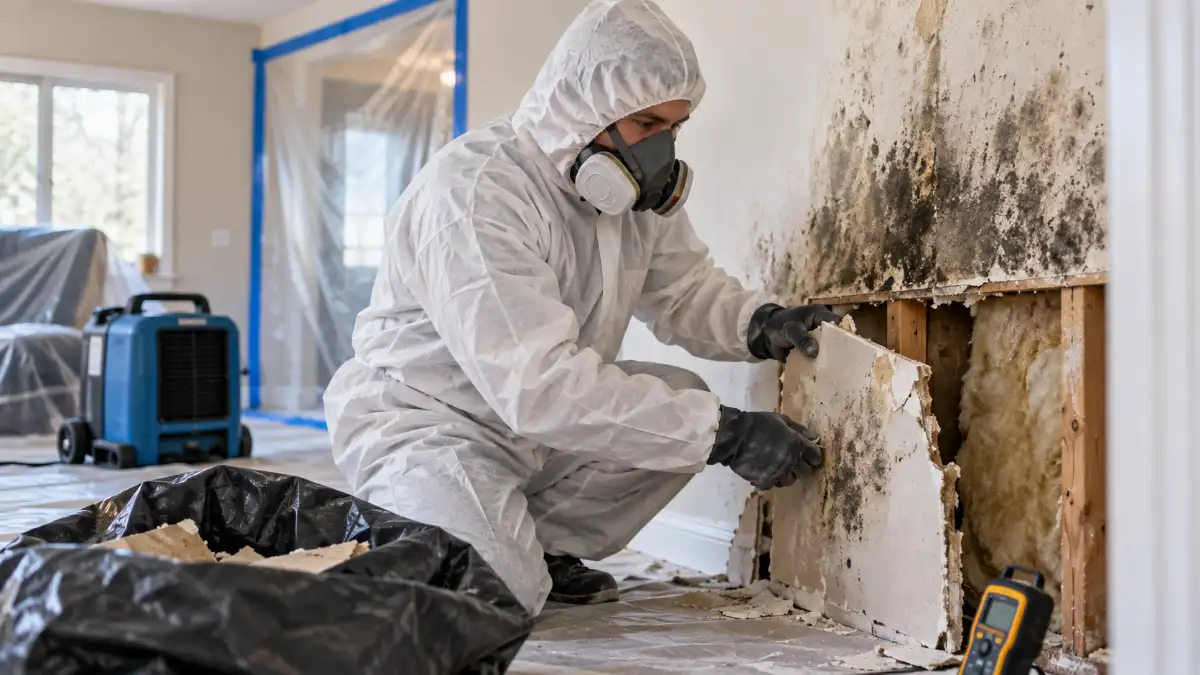
Finding mold in your home can be a cause for concern, especially not knowing how bad the situation is or how long it will take to resolve the issue.
You observe dark places beneath a bathroom ceiling, a dank scent emanating from a cellar, or flawed drywall after an interesting plumbing leak.
Your immediate reaction might be to wipe the surface clean with some household product. But this is not a lot of avoiding the issue, honestly, if you can only clean what has actually been removed.
Mold remediation is the process of removing mold from your environment, identifying and addressing moisture sources, assessing materials impacted by the contamination, removing affected materials, drying the structure or building out properly, and ensuring that necessary conditions which contributed to mold growth have been corrected.
Homeowners can deal with some bottom problems. Some need professional equipment, containment, and expertise.
This Guide breaks down the process from start to finish to help you understand what needs to happen, when it makes sense for professionals to step in, and how you can prevent this issue in the future.
What Is Mold Remediation?
Mold remediation is the process of addressing unwanted mold growth in a building and correcting the conditions that allowed it to develop.
The objective is to remove contamination to an appropriate standard while controlling moisture so that new growth is less likely to occur.
The process may involve several activities:
- Investigating water damage.
- Identifying affected building materials.
- Protecting occupants and unaffected areas.
- Cleaning contaminated surfaces.
- Removing materials that cannot be adequately cleaned.
- Drying the building.
- Verifying that cleanup objectives have been achieved.
The specific work depends on the property and severity of the problem.
A small patch on bathroom tile will not necessarily require the same approach as extensive contamination following a basement flood.
According to the Environmental Protection Agency (EPA), controlling moisture is essential because mold can return when the original water problem remains unresolved.
Mold Removal vs. Mold Remediation
These terms are often used interchangeably, but they can emphasize different aspects of the work.
| Mold removal | Mold remediation |
| Focuses on removing existing contamination | Addresses contamination and contributing conditions |
| May involve limited surface cleaning | Can involve inspection, containment, removal, cleaning, and drying |
| May suit certain small surface problems | Provides a broader approach to complex damage |
| Does not necessarily include water repairs | Should account for the underlying moisture problem |
Neither term guarantees that a contractor will provide a particular service.
Always examine the written scope of work.
- Read more: Mold Remediation
Why Does Mold Grow Inside Homes?
Mold is a natural part of the environment. Its spores exist outdoors and can enter buildings through doors, windows, and ventilation.
Problems develop when those spores encounter suitable materials and enough moisture to support growth.
Many common building materials contain organic substances that can provide nutrients.
These include drywall paper, wood, carpet, and some types of insulation.
However, moisture is the most important condition homeowners can control.
Common Causes of Indoor Mold
Plumbing leaks: A damaged pipe or loose connection may allow water to accumulate behind walls, beneath cabinets, or under flooring.
Roof leaks: Damaged roofing materials and flashing may permit water to enter ceilings and attic spaces.
Poor ventilation: Bathrooms, kitchens, and laundry rooms can develop recurring moisture problems when humid air is not adequately exhausted.
Basement moisture: Water seepage, condensation, and drainage problems can affect basement walls and stored belongings.
Flooding: Floodwater can saturate numerous building materials and may introduce additional contaminants.
HVAC problems: Blocked condensate drains, malfunctioning equipment, and certain duct conditions may contribute to unwanted moisture.
Identifying the actual cause is essential because each problem requires a different corrective measure.
How Quickly Can Mold Develop?
Wet building materials should be dried as soon as possible.
The EPA recommends drying water-damaged areas and belongings within approximately 24–48 hours to help prevent growth.
This is a prevention guideline rather than a guaranteed period during which mold cannot grow.
The actual conditions depend on temperature, moisture, materials, and the surrounding environment.
After a leak, do not rely solely on the appearance of a wall or floor. Concealed materials may remain wet after exposed surfaces appear dry.
How Can You Identify a Mold Problem?
Visible growth is one common indication.
Mold can appear in different colors and textures, including dark spots, irregular patches, or fuzzy-looking growth.
However, visual appearance alone cannot reliably identify a particular species.
Other signs may include persistent musty odors, recurring dampness, water stains, and deterioration of building materials.
A musty smell behind a cabinet may justify investigating the space even when there is no obvious surface growth.
Can Mold Be Hidden?
Yes.
It can develop behind wallpaper, within wall cavities, beneath flooring, and around concealed plumbing.
Hidden problems may be suspected when there has been known water damage, persistent odor, or unexplained moisture.
Avoid unnecessary demolition when the extent of contamination is unknown.
Disturbing affected materials without appropriate precautions may spread contaminated dust.
An experienced professional can evaluate whether targeted investigation is necessary.
Is Black Mold More Dangerous?
Color does not establish the species of mold or reliably predict the health risk.
Dark growth should be investigated and addressed, but so should significant growth of other colors.
There is no need to identify a specific species before correcting an obvious moisture problem and planning appropriate cleanup.
When Should You Hire a Professional?
Not every mold problem requires a remediation company.
The EPA indicates that homeowners can handle many problems involving less than approximately 10 square feet of affected area, provided other complicating conditions are absent.
However, size alone does not determine whether a project is safe.
The water source, contaminated materials, occupant health, and location of growth must also be considered.
| Situation | Suggested approach |
| Small patch on accessible ceramic tile | Careful DIY cleaning may be appropriate |
| Limited growth associated with condensation | Address ventilation and clean suitable surfaces |
| Extensive growth covering more than about 10 sq. ft. | Seek professional guidance |
| Mold inside an HVAC system | Consult an appropriately qualified professional |
| Sewage-contaminated water damage | Obtain specialized assistance |
| Suspected contamination behind walls | Consider professional investigation |
| Household member with significant respiratory vulnerability | Avoid exposing that person to cleanup |
The Centers for Disease Control and Prevention (CDC) advises people with asthma, underlying lung disease, immune suppression, or relevant allergies not to participate in mold cleanup.
The 7 Essential Steps of Mold Remediation
A successful project follows a logical process, although individual steps can vary according to the property and extent of contamination.
Step 1: Investigate and Correct the Moisture Source
The priority is understanding where the water came from.
A contractor may inspect plumbing, roofing, drainage, windows, or HVAC equipment.
Moisture meters and other assessment tools can help identify materials that require further investigation.
Suppose a bedroom wall shows visible growth beneath a window.
The contractor should investigate whether the cause is condensation, failed window sealing, or water entering from outside.
Cleaning the wall without addressing the actual source creates a risk of recurrence.
The remediation plan should identify who is responsible for the necessary repair.
Step 2: Assess the Extent of Damage
Next, determine which surfaces and materials have been affected.
An inspection may reveal that moisture has traveled beyond the visible stain.
For example, a leaking dishwasher may damage the cabinet floor, adjacent drywall, and flooring beneath the appliance.
The assessment should distinguish between materials that can be cleaned and those requiring removal.
For larger projects, the findings should be documented in a written plan.
A practical assessment records the affected locations, suspected moisture source, proposed methods, and expected completion criteria.
Step 3: Establish Appropriate Containment
Containment helps prevent contaminated dust and debris from spreading into unaffected areas.
Depending on project size and conditions, professionals may install protective barriers and use HEPA-filtered equipment.
Occupants may need to avoid the work area.
The HVAC system may also require precautions to prevent contamination from spreading through the building.
Containment should match the actual scope of work.
Extensive demolition near occupied living spaces may require more substantial protection than cleaning a small, accessible surface.
Step 4: Remove Materials That Cannot Be Adequately Cleaned
Some building materials are porous, allowing contamination to penetrate their structure.
Examples include certain carpets, ceiling tiles, insulation, and severely affected drywall.
The EPA explains that moldy absorbent materials may be difficult or impossible to clean completely and may require disposal.
Material decisions should be based on condition, contamination, and restoration feasibility rather than appearance alone.
| Material | Typical remediation consideration |
| Glass and metal | Often suitable for cleaning |
| Ceramic tile | Usually cleanable if surrounding assemblies are sound |
| Drywall | May require removal when substantially contaminated |
| Carpet and padding | May require disposal |
| Insulation | Evaluate contamination and ability to restore |
| Structural wood | May be salvageable through appropriate cleaning and drying |
Structural materials should not be removed unnecessarily.
A qualified professional may need to evaluate whether contaminated wood can be cleaned without compromising the building.
Step 5: Clean Remaining Surfaces
After unsalvageable materials have been removed, the remaining surfaces require appropriate cleaning.
For many hard surfaces, the EPA recommends scrubbing with detergent and water, followed by complete drying.
Professional methods may include HEPA vacuuming and material-specific cleaning techniques.
The objective is to physically remove contamination.
Merely changing the appearance of a surface is not enough.
Painting over mold is not an appropriate substitute for cleaning.
Likewise, chemical treatment alone cannot resolve a continuing moisture problem.
The EPA does not recommend routine use of bleach or other biocides for mold cleanup. Dead mold can still cause allergic reactions, so physical removal matters.
Any cleaning chemical must be used according to its label. Never mix bleach with ammonia or other cleaners.
Step 6: Dry the Structure
Drying is necessary before reconstruction.
Depending on the project, professionals may use dehumidifiers, controlled ventilation, and drying equipment.
Moisture measurements can help track progress.
The objective is to ensure that affected materials have reached appropriate drying conditions.
Simply touching a wall is not a reliable way to establish that concealed materials are dry.
Improper airflow can also spread contamination, so equipment should be used with appropriate precautions.
Step 7: Verify Completion
Before rebuilding, the completed work should be evaluated.
Important questions include:
- Has the moisture source been corrected?
- Has visible contamination been removed?
- Are affected materials adequately dry?
- Is there a continuing moldy odor?
- Have the agreed cleanup objectives been achieved?
Some complex projects benefit from independent post-remediation verification.
Air sampling may be appropriate for specific technical objectives, but it is not required for every situation.
The final assessment should consider the actual building conditions rather than relying exclusively on a laboratory result.
Is Mold Testing Necessary?
Many homeowners assume that testing must happen before any cleaning begins.
However, visible mold often provides sufficient evidence that a cleanup problem exists.
The EPA generally considers sampling unnecessary when visible growth is present.
There are also no federal airborne mold concentration limits against which ordinary indoor test results can be compared.
Testing may still be appropriate when a qualified professional needs to answer a specific investigative question.
Before paying for it, ask how the results will change the proposed work.
A laboratory report identifying a species does not automatically reveal where water is entering the building.
How Long Does Cleanup Take?
The timeline varies considerably.
A small surface problem may be relatively straightforward.
A larger project involving concealed damage, demolition, extensive drying, or reconstruction can require substantially more work.
Factors affecting the schedule include material type, water source, accessibility, equipment requirements, and the availability of repair contractors.
Do not accept a guaranteed completion timeline that ignores moisture conditions.
Ask for a schedule identifying the major stages and circumstances that could cause delays.
Also distinguish between remediation completion and full reconstruction.
A room may be free of contamination but still require drywall installation, flooring repairs, or painting.
What Happens to Furniture and Personal Belongings?
Furniture, clothing, documents, and other possessions should be assessed according to their material and condition.
Hard, nonporous objects may be easier to clean.
Porous belongings can be more difficult to restore.
Valuable or sentimental items may justify specialized conservation or restoration services.
Document damage with photographs before discarding expensive possessions, particularly when insurance may be involved.
Avoid moving contaminated belongings through clean areas without considering safe handling.
How Can You Prevent Mold From Returning?
Long-term prevention depends on managing moisture.
The EPA recommends keeping indoor relative humidity below 60%, ideally between 30% and 50% where practical.
A hygrometer can help monitor indoor conditions.
Other practical measures include repairing leaks promptly, maintaining gutters, improving ventilation, inspecting HVAC drainage, and drying accidental water damage quickly.
Room-by-Room Prevention Checklist
| Area | Recommended maintenance |
| Bathroom | Maintain ventilation and repair plumbing leaks |
| Kitchen | Inspect appliance connections and sink plumbing |
| Basement | Investigate seepage and manage humidity |
| Attic | Inspect roof leaks and moisture conditions |
| Laundry room | Check hoses and appliance drainage |
| Living areas | Address window leaks and recurring condensation |
A normal humidity reading does not eliminate the possibility of a localized plumbing leak.
Inspect previously damaged locations periodically.
Frequently Asked Questions
What is mold remediation?
This refers to the process of treating mold that has unwanted and remediate water circumstances for the problems.
Can I remove mold myself?
Homeowners can clear small, accessible issues. For serious or complicated contamination, you might need to seek professional help.
Does mold always come back after cleaning?
No. Unfortunately, new growth can emerge when either the underlying moisture problem has not been addressed or in instances of further water damage.
Is mold testing required?
Not usually when you can see the actual mold. Testing can serve well for certain investigative questions.
Can mold grow behind drywall?
Yes. Hidden wetness can enable growth within wall assemblies.
Does bleach eliminate mold permanently?
No, they require proper cleaning and moisture control, and regular use of bleach is disallowed by the EPA.
How can mould impact the quality of indoor air?
Yes. Particles associated with mold, which can release spores and chemicals that act as allergens or respiratory irritants in sensitive people, may contribute to exposure.
Am I required to replace all contaminated materials?
No. Some materials can be cleaned and dried; other materials may need to be removed. It depends on the health and contamination of such organs.
What prevents mold from returning?
Leaks should be fixed, humidity controlled, water damage promptly dried, and proper ventilation maintained.