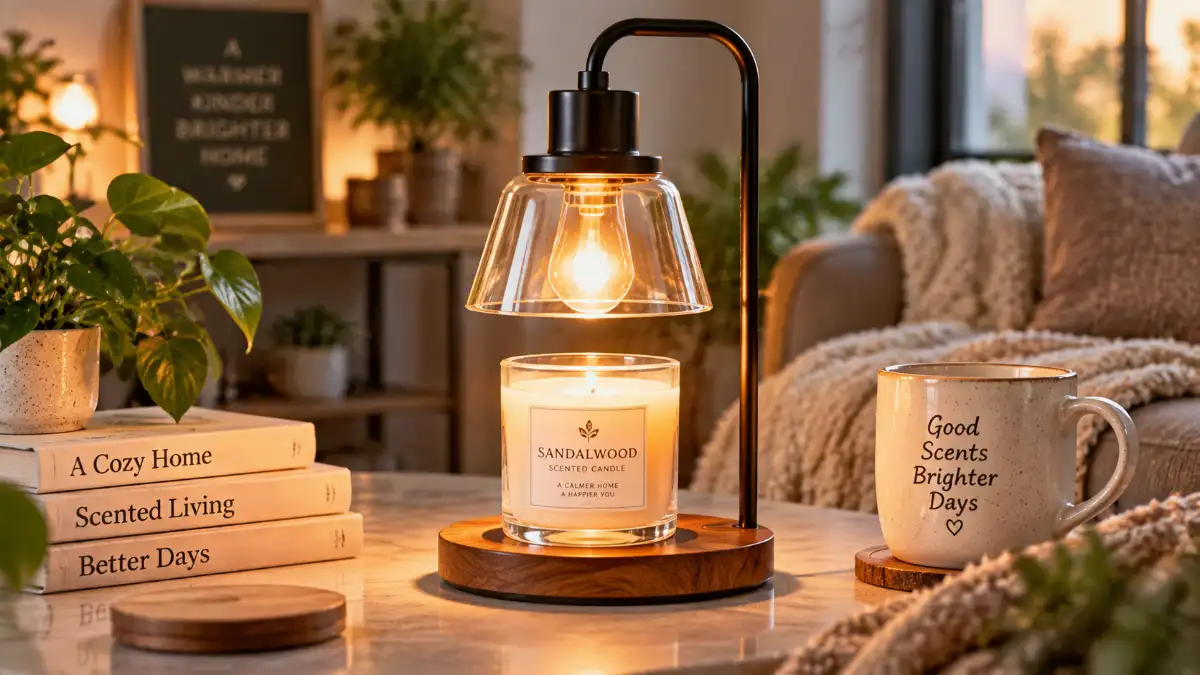
What is a Candle Warmer Lamp? A candle warmer lamp- in essence, an electric bulb used to indirectly warm (via conduction) the wax of a candle from above without lighting the wick and thus producing vapors that create fragrance. Provides a way to go instead of an open flame, but the bulb, candle jar, and molten wax can all get hot.
Selecting the perfect model goes beyond just looking for a model that complements your decor- the same shape, finish, and so on. The candle has to sit under the bulb, there must be a place for the appliance itself, and spare parts should also be available.
In this guide,e you will discover how these lamps work, how to check compatibility before buying one, which features matter, what they cost to operate, and finally tips on using them responsibly.
What Is a Candle Warmer Lamp and How Does It Work?
A candle warmer lamp is an electrical appliance that heats a compatible candle without igniting the wick.
In most of them,m the heating bulb is located above the candle. Heated wax releases the fragrance materials into the surrounding air.
While the flame certainly produces scent and ambient light, it does not provide the combustion element that results from a burning wick. It’s still a unit that produces heat, uses power, and must be placed properly, though.
How top-down heating releases fragrance
The bulb directs heat toward the candle’s upper surface. As the wax becomes warm enough, its top layer softens and melts, allowing fragrance to evaporate.
Unlike a burning candle, the warmer doesn’t consume wax as fuel through a flame.
That doesn’t mean the fragrance lasts indefinitely. Fragrance compounds can gradually dissipate, leaving wax that produces little noticeable scent.
Heating performance varies with the bulb, candle composition, jar dimensions, and room conditions.
- Read more: Candle Warmer Lamp
Lamp vs. warming plate vs. wax-melt warmer
Although these appliances serve similar purposes, they use different heating arrangements.
| Device | Heating method | Main consideration |
| Warmer lamp | Heats a candle from above | Jar dimensions and bulb clearance |
| Warming plate | Heats a suitable vessel from below | Vessel and plate compatibility |
| Wax-melt warmer | Heats wax melts in a designated dish | Compatibility with the intended melts |
A lamp may appeal to someone who already owns jar candles and wants an overhead lighting effect.
A dedicated wax-melt warmer may be more practical for someone who primarily purchases fragrance cubes rather than candles.
Neither heating method guarantees stronger fragrance in every situation.
What a warmer does not do
A warmer is not automatically suitable for use as a reading lamp, even if its bulb produces visible light.
It also doesn’t purify indoor air or eliminate every potential hazard associated with scented products.
The correct way to think about it is as a specialized heating appliance with a secondary decorative function.
Is a Candle Warmer Lamp Right for You?
Before comparing prices or finishes, decide whether a warming lamp suits the candles you own and the space where you intend to use it.
A visually attractive product isn’t a good purchase if your favorite candle cannot fit beneath its bulb.
When a lamp makes sense
A lamp may suit you if you regularly use compatible jar candles and prefer releasing fragrance without lighting a wick.
It can also provide soft ambient lighting on a desk, dresser, or side table, provided the location meets the manufacturer’s placement requirements.
Adjustable models can accommodate different candle sizes within their specified limits.
Remember that scent strength depends on the candle, heating system, and room—not simply the presence of a lamp.
When another type of warmer makes more sense
If you mainly use wax-melt cubes, consider an appliance designed specifically for them.
A warming plate may be another option for suitable candle vessels, although compatibility and heating characteristics differ by model.
If your candles are unusually tall or wide, an overhead lamp may not provide sufficient clearance.
Check actual specifications before deciding that another heating method will solve the problem.
When you should skip the purchase
Delay buying if you cannot identify a stable, suitable location or verify that the appliance supports your candles.
Missing electrical specifications, unclear bulb requirements, or unavailable replacement parts are additional reasons to keep looking.
| Your situation | Recommended next step |
| You own several compatible jar candles | Compare adjustable models |
| You mainly use wax-melt cubes | Consider a dedicated melt warmer |
| Your jars are unusually tall | Check maximum supported height |
| You have limited counter space | Measure the base footprint |
| You lack a stable, suitable surface | Delay the purchase |
The goal is to find a product that works with your actual setup, not to buy a warmer simply because it looks appealing.
✕Compare with AITOPIA
How to Check Whether a Lamp Fits Your Candles
The most useful buying step is also one that is easy to overlook: measure your candle before choosing a lamp.
A candle’s advertised weight doesn’t tell you whether its jar will fit. A 14-ounce candle, for example, might have a different shape from another candle of the same weight.
Use the following method to compare your existing candle with a manufacturer’s published specifications.
Step 1: Measure your candle jar
Use a ruler or measuring tape to record the jar’s maximum diameter and height in inches.
Remove the lid and measure the container itself, including any raised rim or decorative features that could affect clearance.
Record the widest part of the jar, not just the diameter of the wax surface.
Check the container for cracks, chips, loose decorations, or other damage. Don’t place a damaged vessel beneath a heating appliance.
Step 2: Check the lamp’s usable clearance
Look for the manufacturer’s maximum supported candle height and diameter.
Also check the required distance between the bulb and the candle, along with the lamp’s available adjustment range.
An advertised lamp height of 15 inches doesn’t mean it can accommodate a 15-inch candle. The shade, bulb, and base all occupy space.
If a listing provides only the overall lamp dimensions, request the usable clearance from the manufacturer.
Step 3: Verify vessel compatibility
Read the candle maker’s instructions to determine whether the vessel is suitable for the proposed heating method.
Glass containers vary in construction, and not every decorative candle is designed for use beneath an overhead heater.
Avoid candles with damaged jars, unstable containers, or decorative elements that could interfere with the bulb.
If the candle or lamp manufacturer prohibits the combination, don’t use it.
Step 4: Measure the intended location
Measure the surface where you plan to position the appliance.
Check that the entire base fits securely, with sufficient clearance from nearby shelves, curtains, and other objects.
The surface should be stable and suitable for the heat generated during operation.
Consider the power cord, too. It shouldn’t hang where someone could pull it or create a tripping hazard.
Worked candle compatibility example
Imagine you own a jar candle with these measurements:
- Diameter: 3.5 inches
- Height without lid: 4.5 inches
You’re considering a hypothetical lamp whose manufacturer specifies:
- Maximum candle diameter: 4 inches
- Maximum candle height: 5 inches
Your candle passes those two dimensional checks.
However, that doesn’t establish complete compatibility. You must still verify bulb clearance, vessel suitability, placement requirements, and the manufacturer’s other restrictions.
Candle-to-lamp fit worksheet
Use this worksheet before purchasing.
| Measurement | Your candle | Lamp specification |
| Maximum jar diameter | ___ inches | ___ inches |
| Jar height without lid | ___ inches | ___ inches |
| Required bulb clearance | Not applicable | ___ inches |
| Base footprint | Not applicable | ___ × ___ inches |
| Vessel approved for warming? | Check candle maker | Check lamp manual |
| Suitable placement? | Check your space | Follow lamp instructions |
Buying rule: If a required specification is missing, don’t assume the candle will fit. Contact the manufacturer or choose a product with clearer documentation.
Seven Features to Check Before Buying
Once you’ve confirmed that your candles can fit, compare the features that affect everyday use, maintenance, and reliability.
Adjustable height and usable clearance
An adjustable arm can help accommodate different jar sizes within the lamp’s specified range.
However, height adjustment alone doesn’t guarantee compatibility.
Check the minimum and maximum usable clearance, not just whether the product description says “adjustable.”
If you own candles of several sizes, compare each jar against the manufacturer’s limits.
Bulb type and replacement availability
Check the approved bulb type, socket, and wattage before buying.
Some models use heat-producing halogen bulbs, but specifications vary. A replacement must match the manufacturer’s requirements.
A bulb that physically fits the socket isn’t necessarily suitable. An incompatible LED may not provide the required heat, while a higher-wattage bulb could create an overheating hazard.
Confirm that approved replacement bulbs are available before committing to a model.
Timer and automatic shutoff
Timers allow users to select a defined operating period on models that offer this feature.
Some lamps also provide automatic shutoff when the selected period ends.
These functions can be convenient, but they don’t eliminate the need to monitor the appliance.
Turn the lamp off before leaving home or going to sleep, even if it has a timer.
Dimming and heat control
A dimmer adjusts electrical output on compatible models, potentially changing both brightness and heating performance.
This can help users operate the lamp according to its intended settings.
However, a dimmer doesn’t necessarily provide precise temperature control.
Don’t assume that a particular brightness setting corresponds to a verified wax temperature unless the manufacturer supplies that information.
Stable base and construction
Look at the base dimensions and overall design.
The appliance should remain stable when positioned on an appropriate surface with a compatible candle.
Consider whether the shade is securely attached and whether the adjustment mechanism stays in position.
A decorative finish matters less than reliable construction and suitable placement.
Electrical specifications and safety marks
For US shoppers, verify that the product’s electrical specifications are appropriate for the intended power supply.
Look for clear manufacturer information and independently verifiable safety certification or listing where applicable.
An unexplained safety logo in a marketplace photograph isn’t sufficient evidence.
The US Consumer Product Safety Commission maintains recall information that consumers can consult when researching appliances.
Warranty, returns and replacement parts
Check the warranty, return period, and availability of replacement bulbs or other approved parts.
A reasonable return policy is particularly valuable when an online listing provides incomplete dimensions.
If the seller cannot answer basic questions about clearance, electrical specifications, or bulb replacement, consider a better-documented product.
Comparison tip: Create a simple worksheet for two or three shortlisted models. Record their actual specifications for these seven features rather than choosing based on photographs or promotional descriptions.
How Much Does a Candle Warmer Lamp Cost to Run?
Electricity costs depend on the appliance’s power consumption, how long you use it, and your electricity rate.
You can estimate the cost using a straightforward calculation.
Electricity cost formula
First, convert watts into kilowatts by dividing by 1,000.
Then multiply by the hours of use and your electricity rate.
Cost=Watts1000×Hours×Rate per kWh\text{Cost}=\frac{\text{Watts}}{1000}\times\text{Hours}\times\text{Rate per kWh}Cost=1000Watts×Hours×Rate per kWh
Use the appliance’s actual power rating when available. The bulb’s wattage alone may not represent total consumption if the device has additional electrical components.
Worked example with stated assumptions
Consider a hypothetical warmer with the following usage:
| Input | Assumption |
| Power consumption | 35 watts |
| Daily use | 2 hours |
| Electricity rate | $0.20/kWh |
| Calculation period | 30 days |
Daily electricity cost:
0.035×2×$0.20=$0.0140.035\times2\times\$0.20=\$0.0140.035×2×$0.20=$0.014
Thirty-day electricity cost:
$0.014×30=$0.42\$0.014\times30=\$0.42$0.014×30=$0.42
Under these assumptions, the appliance costs approximately 42 cents in electricity over 30 days.
This is an illustrative calculation, not a measured cost for a particular product or a claim about the average US electricity rate.
Actual costs depend on your appliance, settings, usage, and utility tariff.
Other ownership costs
Electricity is only one expense.
Consider the initial purchase price, approved replacement bulbs, and any candles you purchase.
Some users may get more fragrance sessions from a candle when warming it instead of burning it, but results vary. Wax remaining in a jar doesn’t mean the fragrance remains equally strong.
Without evidence from comparable testing, it’s misleading to promise that every warmer will save money or double candle life.
✕Compare with AITOPIA
How to Use a Candle Warmer Lamp Safely
A warming lamp is straightforward to operate, but safe use depends on the instructions for your specific model.
Don’t substitute general internet advice for the manufacturer’s requirements.
Step 1: Read the manufacturer’s instructions
Before plugging in the appliance, check its electrical requirements, approved bulb type, compatible candle sizes, and required clearances.
Inspect the cord, plug, bulb, and lamp for visible damage.
Don’t use an appliance with damaged electrical components or a loose or broken bulb.
Check the CPSC recall database if you have concerns about a particular model.
Step 2: Choose a suitable location
Position the appliance on a stable, heat-resistant surface.
Keep it away from edges, curtains, loose papers, and other combustible materials.
Make sure children and pets cannot reach the appliance, pull its cord, or knock over the candle.
Avoid crowded shelves or enclosed spaces unless the manufacturer specifically approves that placement.
Step 3: Position the candle
Remove the candle’s lid and center the compatible jar beneath the bulb.
Check the required clearance between the bulb and the candle.
Don’t guess a universal distance. Different lamps have different designs and heating characteristics.
Never light the candle’s wick while the jar is positioned beneath an operating warmer.
Step 4: Turn on the lamp and monitor the wax
Switch on the appliance using its approved controls.
The upper wax surface should gradually warm according to the product’s intended operation.
Melting time varies with the bulb, wax composition, jar dimensions, and starting temperature.
Monitor the appliance during use. If you notice unusual heat, smoke, electrical odors, or other signs of malfunction, switch it off and follow the manufacturer’s troubleshooting instructions.
Step 5: Switch off and allow everything to cool
Turn the lamp off before leaving home or going to sleep.
Allow the bulb, shade, candle vessel, and melted wax to cool completely before touching, moving, cleaning, or replacing components.
Don’t pour or handle hot wax unless the candle maker specifically provides an approved procedure.
Essential safety reminder
A flame-free appliance can still cause burns or other hazards. Never light a candle beneath an operating warmer, and always follow the instructions supplied with both products.
Candle Warmer Lamp Safety: What You Need to Know
Removing an open flame changes the hazards associated with using a candle, but it doesn’t eliminate every risk.
Understanding the remaining hazards is important when deciding where and how to use the appliance.
Flame-free does not mean risk-free
A warming lamp contains electrical components and generates heat.
The bulb, shade, candle jar, and wax may become hot enough to cause burns. Spilled wax, unstable placement, and electrical faults can create additional hazards.
The CPSC has previously recalled certain electric candle warmers because of fire hazards. Those recalls concerned specific products and do not mean every warmer is defective, but they show why product quality and proper use matter.
Choose a well-documented appliance, inspect it regularly, and discontinue use if you notice damage or malfunction.
What about children and pets?
Keep the appliance in a location inaccessible to children and pets.
A trailing cord can allow someone to pull the lamp off a table, while an exposed hot jar or bulb may cause burns.
Avoid placing the warmer on narrow furniture or surfaces that can be easily bumped.
A timer isn’t a substitute for appropriate placement and supervision.
Do candle warmers affect indoor air quality?
A warmer doesn’t burn the wick, so it avoids emissions produced specifically by wick combustion.
However, heated fragranced products can still release substances into indoor air. Fragrance ingredients may also react with other indoor pollutants.
The US Environmental Protection Agency identifies burning candles as a source of indoor particulate matter and explains that certain fragranced consumer products can contribute to indoor air pollution through emissions and chemical reactions. These findings don’t establish the emissions of every warmer model.
If fragrances cause discomfort, consider reducing use or avoiding fragranced products. Ventilation and following product instructions remain important.
Don’t describe any warmer as completely pollution-free without appropriate product-specific evidence.
Can you leave a warmer on overnight?
Switch it off before going to sleep.
Even models with timers or automatic shutoff contain heating and electrical components.
Follow the manufacturer’s operating instructions and don’t treat an automatic timer as permission to leave the appliance unattended.
✕Compare with AITOPIA
Common Problems and How to Fix Them
If your warmer isn’t performing as expected, start with simple checks that don’t involve opening the appliance or modifying its electrical components.
Always switch it off and allow it to cool before inspecting the bulb or repositioning a hot candle.
The wax is not melting evenly.
Uneven melting may occur when the candle isn’t positioned correctly, the jar is incompatible, or the heating arrangement doesn’t suit its dimensions.
Check whether the candle is centered and whether the bulb and controls match the manufacturer’s instructions.
Don’t move a hot jar or reduce the bulb clearance beyond the approved limit to force faster melting.
The lamp produces little fragrance
First, determine whether the wax has warmed as intended.
If the wax is melting but fragrance remains weak, the candle may have lost some of its fragrance through previous use.
Room size and airflow can also affect how noticeable a scent feels.
Avoid installing a higher-wattage bulb or exceeding the recommended operating settings to increase fragrance.
The bulb stops working
Turn off and unplug the appliance, then allow it to cool completely.
Check the manual for the approved replacement bulb’s socket, type, and wattage.
Use only a replacement that meets the manufacturer’s specifications.
If an approved bulb doesn’t resolve the problem, contact the manufacturer rather than attempting unauthorized electrical repairs.
If the jar or surrounding surface becomes unusually hot
Switch off the appliance.
Allow everything to cool, then check the manufacturer’s placement and compatibility requirements.
Don’t continue operating a lamp that appears to be overheating or damaging its surroundings.
If you cannot identify the problem, stop using the product and contact the manufacturer.
The candle no longer smells strong
Fragrance can gradually diminish even when substantial wax remains.
That doesn’t necessarily indicate a faulty lamp.
Follow the candle maker’s instructions for handling wax that no longer produces sufficient fragrance. Don’t assume that removing hot wax or adding fragrance oil is safe.
Quick troubleshooting table
| Problem | What to check | Appropriate next step |
| Uneven melting | Position and jar compatibility | Recheck the instructions |
| Weak fragrance | Wax temperature and candle condition | Review approved operation |
| Bulb failure | Replacement specifications | Replace only after cooling |
| Excessive heat | Clearance and compatibility | Switch off and investigate |
| Fading scent | Remaining fragrance | Follow candle maker’s guidance |
If troubleshooting requires electrical disassembly, stop and seek assistance from the manufacturer or an appropriately qualified repair professional.
Candle Warmer Lamp vs. Burning a Candle: Which Fits Your Needs?
Both methods can release fragrance, but they create different experiences and require different precautions.
Your preference may depend on whether you value a visible flame, ambient lighting, reduced wick maintenance, or compatibility with candles you already own.
Fragrance and ambiance
A burning candle provides the movement and appearance of a real flame.
A warming lamp produces light from its bulb while heating the candle without igniting the wick.
Neither method guarantees stronger fragrance. Results depend on the candle formulation, heating conditions, room size, and airflow.
If you specifically want the appearance of a flame, a warming lamp won’t reproduce it.
Safety and maintenance
Burning candles require precautions associated with an open flame, including suitable placement and wick care.
A warming lamp eliminates the burning wick during its intended use but introduces electrical components and heated surfaces.
Both methods require attention, appropriate placement, and manufacturer-approved operation.
A lamp also requires occasional bulb replacement and appliance inspection.
Candle longevity and overall value
When a candle burns, wax serves as fuel and is gradually consumed.
When it is warmed without a flame, the wax isn’t consumed through combustion, although some material may evaporate and fragrance gradually diminishes.
That difference doesn’t establish a universal lifespan multiplier.
To evaluate value, consider the appliance’s purchase price, electricity use, bulb replacements, and your actual candle consumption.
| Factor | Warmer lamp | Burning candle |
| Open flame | No | Yes |
| Electricity required | Yes | No |
| Hot components | Yes | Yes |
| Wick combustion | No | Yes |
| Wax consumed as fuel | Not through combustion | Yes |
| Fragrance longevity | Varies | Varies |
| Main maintenance | Bulb and appliance care | Wick and vessel care |
A warmer may suit someone who wants fragrance without lighting a wick. Burning a candle may appeal to someone who specifically enjoys a visible flame.
Neither option removes the need for careful use.
✕Compare with AITOPIA
Frequently Asked Questions
What is a candle warmer lamp?
An electric device with a bulb that emits light, which heats an adequately scented candle from above. This heats the wax to soften and melt it sufficiently so that fragrance can escape without igniting the wick. It was meant to be an ambient light source.
Candle Warmers 101: What is a Candle Warmer? How Do Candle Warmers Work?
The bulb concentrates heat over the upper wax surface of a candle. In its heated state, the fragrance molecules from the melted wax vaporize and disperse into the ambient air. And it accomplishes this without actually burning wicks, which means both your device and your candle get warmed up- which is not how a real candle burns.
Now you are thinking: is a candle warmer lamp safer than burning candles?
They serve a much safer role than an open flame, but are not without danger. With a little more training, sure- burnt-out bulbs, liquid wax leaking everywhere, loose cables, and an unstable base are still kinds of dangerous. All aspects are including product quality, compatibility with other products,s and positioning, ng need to perform according to the technical specifications of the manufacturer to operate the fiber optic equipment safely when it is time.
Is it possible to use any candle for warm lamps?
Nay height jar eh then but a fuckiger to head and clear area (clear area be how much it should hrtr ka) oe ees dmboooks sdyou bbs aisies nay mad aa dilk etc…. Never thinking that all glass jars are similar.
A candle warmer should not go beyond 2 to max. 4 hours.
Follow your model’s operating instructions. There is no rule of thumb; there is no universal appliance time limit. The approved utility and efficiency of warming are different. Use the warmer, but be careful- you must remember to turn it off before sleeping or going out.
What if you left a candle warmer lamp on overnight?
So, what I think is a f*ing massive no-brainer: No. Just switch it off before you head to bed! Automatic shutoff/self-shut down timers aren’t life-saving devices. They won’t stop dangerous heat/electrical hazards. When using the appliance, always follow the directions carefully and never leave it unattended while running.
Candle Warmer Lamps- Do they prolong the life of candles?
And that they don’t burn wax for fire, and that they can be reheated many times and have lots of wax unburned. However, fragrance gradually diminishes. There is no evidence that all paraffin and soy wax burn twice as long; it varies greatly from the candle and use conditions.
Bulb For Candle Warmer Lamp
We also recommend looking to the bulb producer for choosing the sort, socket, and wattage of the energy-efficient bulb for your fixture. A variety of designs are lodged between the best warming halogen bulbs, and lots of designs use top warming halogen bulbs. And don’t simply toss in a higher-watt bulb, or one that is rated for the wrong kind of lamp just because it fits and looks great.
Final Thoughts: My Candle Warmer Lamp is NOT melting the wax?
For mostly these are disallowed candles(mismatched candle, candle in disallowed location), a lead bulb(misconducted as failing), and mishandling. Confirm with OEM-approved specs. No monkeying around, like clamping down mandatory clearances or cramming in a high-lumen bulb, never.
Is a Candle Warmer Lamp Right for You?
If you are someone who uses compatible jar candles on a regular basis, has a good amount of time to spare, and would like to save the scented votive without an open flame, this is probably worth it. Before buying the thing, compare the jar size, best usable clearance, needed electrical power, and replacement-bulb availability, along with TCO (Total cost of ownership).