
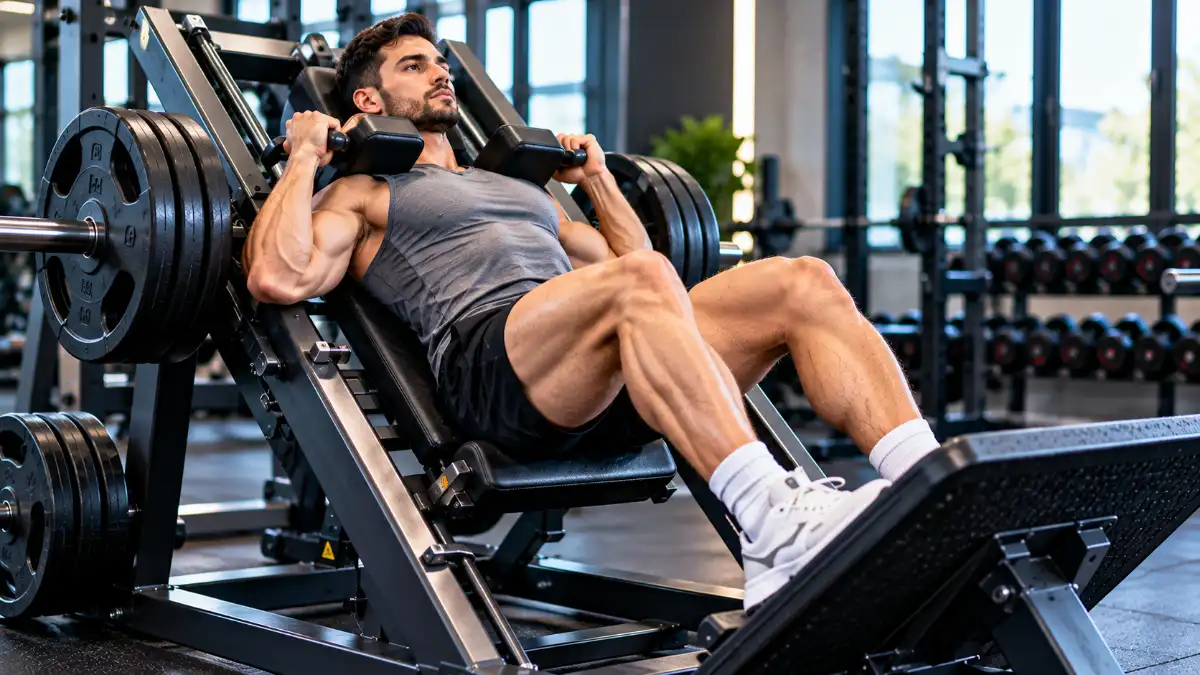
The hack squat is a machine-based lower-body exercise that primarily trains your quadriceps while also working your glutes and inner thighs. You stand beneath padded shoulder supports, keep your back against a pad, and move a weighted sled along a fixed track. Below, you’ll learn how to set up the machine, squat comfortably through a useful range of motion, adjust your foot placement, and decide where this exercise fits in your leg routine.
What Is a Hack Squat?
Most gym-goers mean the sled-machine version: a slanted track, shoulder pads, a backrest, a foot platform, and safety catches. You bend your knees and hips to lower the sled, then extend them to stand. The movement resembles a squat, although the machine guides your path.
There is also a barbell hack squat, performed with the bar behind your legs.
What Muscles Does the Hack Squat Work?
Your quadriceps straighten your knees and do much of the work as you drive upward. Your gluteus maximus contributes to hip extension, while the adductor magnus and other thigh muscles assist.
Because the backrest supports your torso, the movement typically demands less trunk stabilization than a barbell back squat. In a study involving ten men, researchers recorded greater trunk-muscle activation during back squats at comparable relative loads. Read the back squat and hack squat activation study.
PubMed
How to Do a Hack Squat With Proper Form
- Choose a light load and adjust the machine so the pads fit your shoulders comfortably.
- Place your feet about shoulder-width apart, near the middle of the platform, with heels fully supported.
- Press your back and hips against the pad, brace your abdomen, and grasp the handles.
- Extend your legs enough to release the safety catches according to the machine’s instructions.
- Bend your knees and hips slowly. Keep your feet planted and let your knees follow the direction of your toes.
- Lower as far as you can without pain or losing contact with the backrest.
- Push through your whole foot, rise smoothly, and avoid forcefully snapping your knees straight.
- After the final repetition, engage the safety catches before stepping away.
Machines differ, so follow the equipment instructions when the release mechanism is unfamiliar.
How Deep Should You Go?
There is no universally correct bottom position. Aim for the deepest range you can manage with steady heels, your hips against the pad, and no sharp pain. For some people, that means thighs around parallel; others can comfortably descend farther.
Depth changes how your knees and hips are loaded. A 2024 biomechanical review of squat technique explains how squat depth, stance, and body position affect joint demands.
PubMed
Hack Squat Foot Placement
Start with a shoulder-width stance near the platform’s center. Keep your heels planted throughout each repetition.
Lower foot positions can permit greater forward knee movement, while higher positions may change hip and knee demands. However, precise muscle-targeting claims are hard to generalize across different machines and bodies.
Move your feet only a little at a time. Favor a stable position that lets you work through a comfortable range instead of trying to isolate one tiny section of the quadriceps.
Benefits of the Hack Squat
The biggest practical benefit is stability. With less balance to manage, you can concentrate on leg effort, controlled repetitions, and consistent depth. That makes the movement useful for quadriceps-focused training and additional leg volume after free-weight lifts.
Machine training isn’t inherently better than free weights. It is simply another effective option, particularly when your goal is to challenge the legs without making barbell coordination the limiting factor.
Hack Squat vs. Back Squat
Both movements involve the knees and hips, but they challenge the rest of your body differently. A back squat requires you to balance a barbell and stabilize your trunk. The machine supports your torso and directs the sled along rails.
The published trunk-activation comparison found greater trunk activity during back squats in its small study group, despite heavier absolute loads on the hack-squat machine.
PubMed
Want stronger barbell squats? Keep practicing the barbell version. Want extra quadriceps work with more external support? The machine can complement it.
Hack Squat vs. Leg Press
A typical leg press supports your back on a seat while you push a platform or sled away. On the hack squat machine, your body travels along the track in a more squat-like orientation. Both work the quadriceps and glutes, with differences in comfort, joint angles, and machine design.
Neither guarantees superior results.
How Many Sets and Reps Should You Do?
For muscle building, two to four working sets of 6–15 repetitions is a reasonable starting suggestion, not a mandatory prescription. Beginners can start with two lighter sets while learning the setup. More experienced lifters may use heavier or higher-repetition work depending on their program.
Keep the last repetitions challenging without bouncing or shortening your depth. Add repetitions first, or raise the load slightly when all your reps remain controlled.
Common Hack Squat Mistakes
Loading too many plates before learning the movement is an easy way to lose depth and control. Other mistakes include lifting your heels, letting your knees collapse inward, rushing the descent, or allowing your hips to peel away from the pad.
Adjust your setup, reduce the resistance if necessary, and aim for repetitions that look similar from start to finish. Never bounce aggressively out of the bottom position.
Who Should Be Careful With the Hack Squat?
The exercise can place considerable demands on your knees and hips, especially with heavy resistance or deep knee bending. That doesn’t make it inherently harmful, but discomfort deserves attention. Stop if you experience sharp pain rather than attempting to push through it.
If you have a current injury, persistent joint pain, or recent surgery, ask a qualified healthcare professional or physical therapist whether this movement fits your situation.
Conclusion
The hack squat offers a stable way to challenge your quadriceps, glutes, and supporting leg muscles. Start with a comfortable foot position, learn the safety mechanism, use controlled depth, and increase resistance gradually.
- Read more: Hack Squat
Frequently Asked Questions
Is the hack squat good for building quads?
Yes. Your quadriceps produce much of the knee-extension effort, making this a useful movement for adding quad-focused training volume.
Is a hack squat easier than a regular squat?
It’s generally easier to balance because the sled guides your movement. However, a challenging set can still require substantial leg effort.
Does the hack squat work the glutes?
Yes. Your glutes contribute to extending your hips as you rise, though their involvement varies with your depth and technique.
Is the hack squat bad for your knees?
Not necessarily. Joint tolerance, technique, resistance, and range of motion all matter. Persistent or sharp pain warrants professional guidance.
Should your knees go past your toes?
They can. Some forward knee travel is normal in squatting. Maintain planted feet and use a pain-free, controlled range.
Where should I place my feet?
Start around shoulder width near the platform’s middle. Adjust slightly until your heels stay down and your knees track comfortably.
Can beginners use a hack squat machine?
Yes. Begin with light resistance, learn the safety catches, and prioritize consistent, controlled repetitions before adding weight.
What exercises can replace the hack squat?
Leg presses, goblet squats, front squats, Smith-machine squats, and split squats are useful alternatives, depending on equipment and goals.
Can the hack squat replace barbell squats?
For general leg development, it can be an alternative. For barbell-specific strength and technique, keep the barbell squat in your training.


