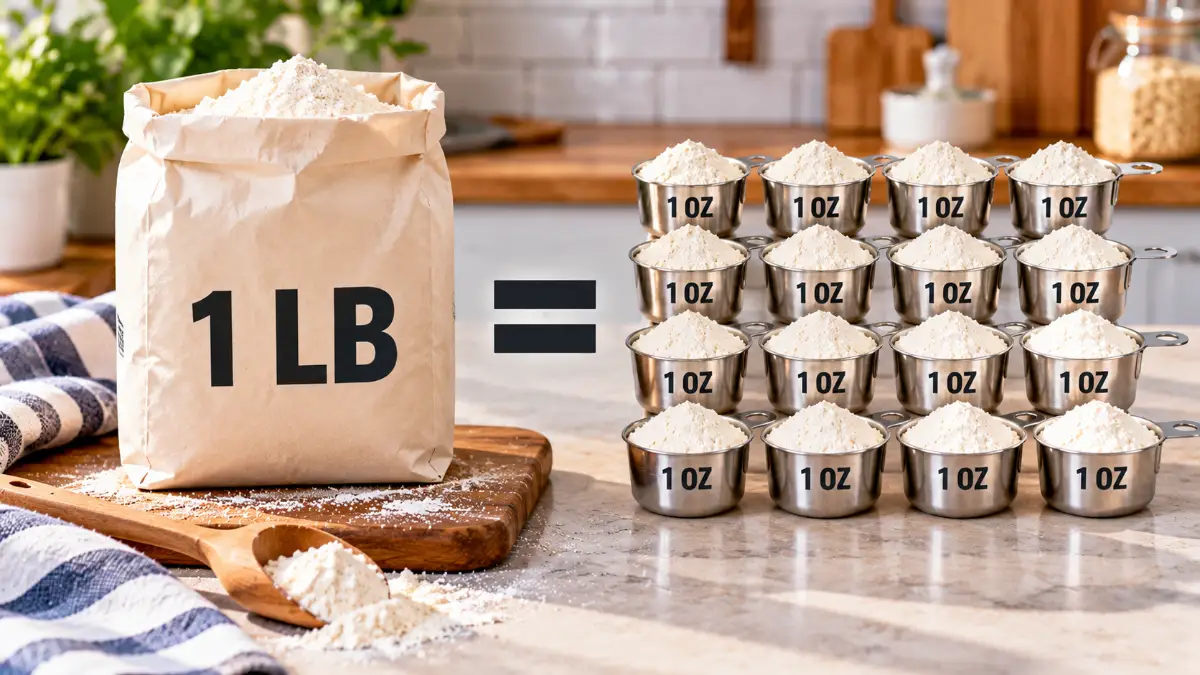
One pound contains exactly 16 ounces in the standard US customary weight system. However, if you’re searching for how many oz in a pound while following a recipe, reading a food label, or preparing a shipping package, it’s important to understand which measurement you’re using. Ordinary ounces measure weight, while fluid ounces measure volume. Precious metals may use troy ounces, which follow a different conversion system. The 16-ounce rule is reliable for everyday weighing, but it cannot answer every question involving fluid volume or specialized units. These seven practical facts explain how to use pounds and ounces correctly without confusing different types of measurement.
1. One Pound Equals 16 Ounces in Everyday Measurements
The United States commonly uses the avoirdupois system for measuring the weight of food, household products, packages, and other everyday items.
In this system:
1 pound = 16 ounces
The relationship is exact, not an estimate.
According to the NIST Handbook 44 measurement tables, the avoirdupois pound is divided into 16 avoirdupois ounces.
This means a pound of chicken, a pound of flour, and a pound of potatoes all weigh the same amount, even though their sizes and volumes differ.
The conversion is straightforward:
- 0.25 lb = 4 oz
- 0.5 lb = 8 oz
- 1 lb = 16 oz
- 1.5 lb = 24 oz
- 2 lb = 32 oz
Knowing these values is especially useful when measurements appear in different units.
2. Ounces and Fluid Ounces Measure Different Things
One of the most common sources of confusion is the difference between ounces and fluid ounces.
An ordinary ounce, abbreviated oz, measures weight or mass.
A fluid ounce, abbreviated fl oz, measures volume.
For example, a recipe may specify 8 ounces of cheese by weight and 8 fluid ounces of milk by volume. Those instructions describe different kinds of measurements.
In US customary volume units:
8 US fluid ounces = 1 US cup
However, a cup of flour does not weigh the same as a cup of honey. They occupy the same volume when measured in identical cups, but their masses differ.
Consequently, you cannot assume that 16 fluid ounces of every liquid weigh exactly one pound.
To convert a fluid measurement to weight, you need the substance’s density and the relevant measurement conditions.
3. Cooking Measurements Depend on Weight and Volume
Home recipes use several units, including pounds, ounces, cups, teaspoons, tablespoons, and fluid ounces.
Understanding their differences can improve measurement accuracy.
Measuring Ingredients by Weight
When a recipe requires 1 pound of an ingredient, it means 16 ounces by weight.
If the recipe calls for half a pound of shredded cheese, you need 8 ounces by weight.
The most reliable way to measure that amount is with a kitchen scale.
Measuring Ingredients by Volume
Recipes sometimes list liquids in cups or fluid ounces.
One US cup contains 8 US fluid ounces, and two US cups contain 16 US fluid ounces.
Those figures describe volume rather than weight.
A recipe asking for 16 fluid ounces of an ingredient is requesting a particular volume, not automatically one pound of that ingredient.
Scaling Recipes Correctly
Suppose a recipe calls for 1.5 pounds of ground beef, but your scale displays ounces.
Multiply 1.5 by 16.
The result is 24 ounces.
If you’re reducing the recipe by half, divide 24 by 2. You’ll need 12 ounces of ground beef.
Converting all weight measurements into the same unit makes recipe adjustments simpler.
4. Food Labels Distinguish Net Weight From Package Weight
Food packaging frequently displays measurements such as:
NET WT 16 OZ (1 LB)
This means the declared net weight of the food is 16 ounces, equivalent to one pound.
It does not mean the food and its packaging together weigh one pound.
The US Food and Drug Administration explains the distinction in its official guidance on net quantity declarations.
The net quantity statement identifies the amount of product inside the package, excluding the container and ordinary packaging materials.
For example, imagine a packaged product with:
- Food weight: 16 oz
- Packaging weight: 2 oz
- Total packaged weight: 18 oz
Its net weight is still 16 ounces, even though the complete package weighs 18 ounces.
This distinction matters when checking food quantities or comparing products.
Comparing Grocery Package Sizes
Suppose one package contains 12 ounces and another contains 1 pound.
Convert the pound to 16 ounces before comparing them.
The second package contains 4 additional ounces.
For a meaningful price comparison, calculate each product’s price per ounce rather than assuming the larger package offers better value.
5. Shipping Weight and Billable Weight Are Not Always Equal
When preparing a package for shipping, ounces and pounds help describe its physical weight.
A package weighing 2 pounds and 6 ounces has an actual weight of:
(2 × 16) + 6 = 38 ounces
However, knowing the actual weight does not always tell you the postage charge.
Shipping providers may apply rounding requirements, dimensional-weight calculations, and service-specific pricing rules.
Understanding USPS Weight Rounding
Under published USPS Ground Advantage rules, parcels above 15.999 ounces generally move into pound-based pricing tiers.
For example, an eligible package weighing 8.3 pounds may be charged at the 9-pound rate.
The exact application depends on the service and pricing category.
What Is Dimensional Weight?
Dimensional weight is a shipping calculation that considers how much space a package occupies.
A large, lightweight box may be charged using its dimensional weight rather than its actual physical weight.
According to the USPS Ground Advantage shipping guidance, qualifying parcels larger than one cubic foot can be subject to dimensional-weight pricing.
This is why measuring package dimensions is important in addition to weighing the parcel.
A practical approach is to record the package’s actual weight, measure the box, and check the carrier’s current price calculator.
6. Troy Ounces Follow a Different Weight System
The standard 16-ounce conversion doesn’t apply to every type of pound.
Gold, silver, and other precious metals are commonly measured in troy ounces.
In the troy system:
1 troy pound = 12 troy ounces
A troy ounce is heavier than an ordinary avoirdupois ounce.
Here is the difference:
| Measurement | Approximate Mass |
| 1 avoirdupois ounce | 28.3495 grams |
| 1 troy ounce | 31.1035 grams |
| 1 avoirdupois pound | 453.5924 grams |
| 1 troy pound | 373.2417 grams |
The NIST Guide to SI unit conversions distinguishes avoirdupois and troy units.
Although a troy ounce is heavier than an ordinary ounce, a troy pound is lighter than an ordinary pound because it contains only 12 troy ounces.
When reviewing precious-metal weights, look for terms such as troy ounce, oz t, or ozt.
7. Metric Conversions Make Weight Comparisons Easier
Some imported products and international recipes use grams and kilograms instead of pounds and ounces.
The exact avoirdupois-pound conversion is:
1 pound = 453.59237 grams
One ordinary ounce equals 28.349523125 grams.
For everyday calculations, these approximate values are convenient:
| US Weight | Metric Weight |
| 4 oz | 113.40 g |
| 8 oz | 226.80 g |
| 12 oz | 340.19 g |
| 16 oz | 453.59 g |
| 1 lb | 453.59 g |
| 2 lb | 907.18 g |
When using a digital scale, you can often switch directly between grams and ounces.
This avoids unnecessary calculations and makes it easier to follow recipes written with different measurement systems.
How to Choose the Correct Conversion
Before converting any measurement, look at its abbreviation and the situation in which it appears.
For ordinary pounds and ounces, multiply pounds by 16.
For a measurement in fluid ounces, determine whether you need a volume conversion or an actual weight calculation.
For precious metals, verify whether the weight is expressed in troy ounces.
For packages, distinguish physical weight from the weight a shipping carrier uses for billing.
Checking the measurement type first prevents errors that a calculator alone cannot catch.
Conclusion
For standard US weight, one pound equals 16 ounces. This relationship works for food, groceries, household products, and physical package weights. The key is recognizing exceptions: fluid ounces describe volume, troy ounces use another weight system, and shipping charges may depend on dimensional weight or rounding. Once you’ve identified the correct unit, the calculation becomes much easier.
- Read more: How Many Oz in a Pound
Frequently Asked Questions
Is one pound always 16 ounces when cooking?
Yes, when the recipe uses ordinary avoirdupois weight measurements. One pound of any ingredient equals 16 ounces by weight.
Are 16 fluid ounces equal to one pound?
Not necessarily. Fluid ounces measure volume. The corresponding weight depends on the substance’s density.
How many ounces are in one pound of butter?
One pound of butter weighs 16 ounces. That is equivalent to four standard US sticks of butter, each weighing 4 ounces.
How many ounces are in one pound of flour?
One pound of flour weighs 16 ounces. Its volume in cups varies with the type of flour and how it is measured.
Does a food label showing 16 oz mean one pound?
Yes, if it states 16 ounces of net weight. The package’s container and ordinary packaging materials are excluded from that net weight.
Does USPS always charge by actual package weight?
No. Depending on the service and package dimensions, USPS may apply rounding or dimensional-weight pricing.
How many troy ounces are in a pound?
One troy pound contains 12 troy ounces. An ordinary avoirdupois pound contains 16 avoirdupois ounces.
Is a troy ounce heavier than a regular ounce?
Yes. A troy ounce weighs approximately 31.1035 grams, compared with approximately 28.3495 grams for an ordinary ounce.
Should I measure baking ingredients in grams or ounces?
Either unit can work accurately when using a suitable scale. Grams are often convenient for precise recipe scaling because metric units use a decimal system.