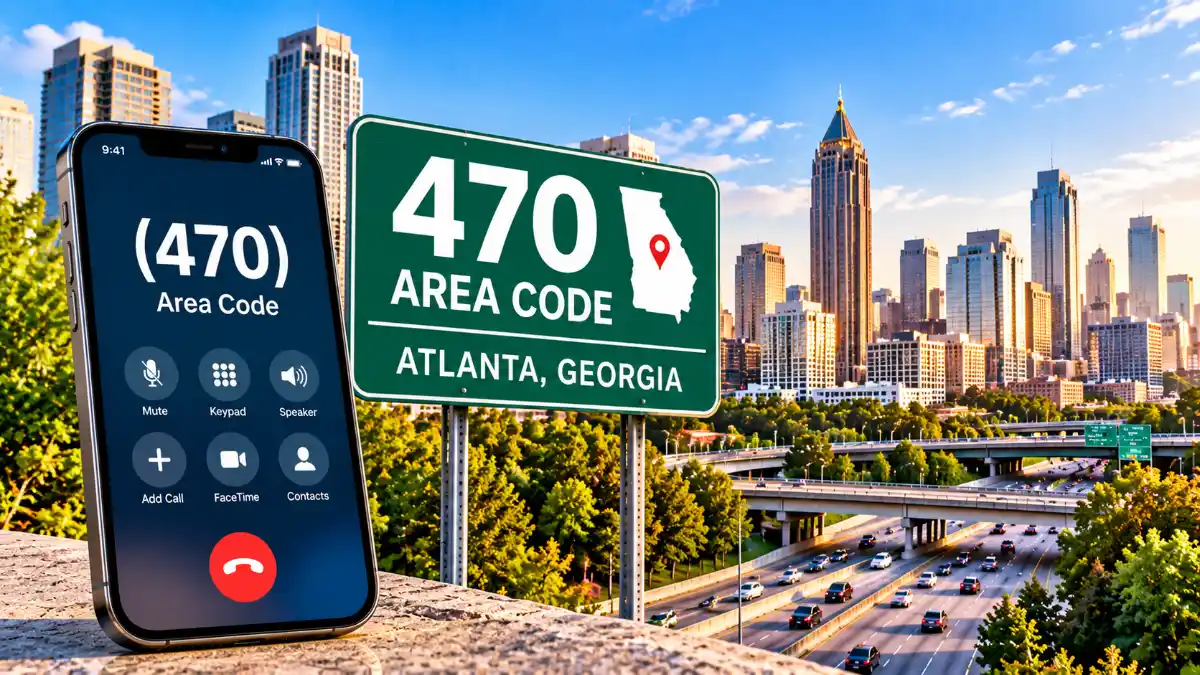
The 470 area code belongs to the Atlanta metropolitan region in Georgia, but a call displaying 470 doesn’t necessarily originate there. The number could belong to a legitimate resident, business, or someone who has moved away. It could also be displayed through caller-ID spoofing, which makes an incoming call appear to come from a different number. The area code itself is legitimate, so there’s no reason to assume every 470 call is a scam.
If an unfamiliar 470 number has been calling or texting you, the safest approach is to look at the caller’s behavior, verify their identity independently, and avoid sharing sensitive information with anyone you cannot identify.
Why Am I Receiving Calls From a 470 Number?
Area code 470 serves Atlanta and surrounding Georgia communities. Someone calling from this number might be a local business, healthcare office, employer, delivery service, contractor, or private individual.
There are other possibilities, too.
A person who originally obtained a Georgia number may have kept it after moving to another state. Some businesses use internet-based telephone systems that aren’t tied to an employee’s current physical location.
Unfortunately, telemarketers and scammers may also use numbers displaying 470.
The area code identifies the number’s geographic numbering assignment, not necessarily the caller’s identity or location.
Is the 470 Area Code a Scam?
No. The 470 area code is a legitimate part of the North American telephone numbering system.
It serves the same broader Atlanta region as 404, 678, 770, and 943.
A particular call from a 470 number can certainly be fraudulent, but that doesn’t make every number in the area code suspicious.
A useful distinction is to separate the numbering region from the person making the call.
The former can be identified through official numbering records. The latter requires independent verification, especially when money or account security is involved.
How Can Scammers Make a 470 Call Look Local?
Fraudsters sometimes manipulate the telephone number shown on caller ID.
This practice is called caller-ID spoofing.
The Federal Trade Commission explains that scammers can make calls appear to originate from familiar businesses, government agencies, or local telephone numbers.
For example, someone outside Georgia could make a call appear to come from a 470 number.
Even if the displayed number belongs to a real Atlanta resident, that person might have nothing to do with the suspicious call.
What Is Neighbor Spoofing?
Neighbor spoofing involves displaying a number that resembles the recipient’s own area code or telephone prefix.
A local-looking number can encourage someone to answer because they assume the call is from a nearby person or business.
However, the familiar digits don’t verify the caller’s identity.
That’s why caller ID should be treated as a clue rather than proof.
9 Warning Signs of a Suspicious 470 Call
The strongest signs of phone fraud usually come from what the caller says or demands.
1. Immediate Payment Demands
Be suspicious if someone unexpectedly insists that you must pay immediately to avoid a penalty or serious consequence.
A manufactured deadline can prevent you from checking whether the request is genuine.
2. Requests for Verification Codes
A caller asking you to read out a one-time login or security code may be trying to access your account.
Never share an unexpected authentication code with someone who called you.
3. Threats of Arrest or Legal Action
Scammers may impersonate government employees or law enforcement officers and threaten consequences unless you comply.
End the call and independently verify any claimed official matter.
4. Unusual Payment Instructions
Gift cards, cryptocurrency, and wire transfers are common warning signs when an unexpected caller demands payment.
The FTC advises consumers to be cautious when callers insist on payment methods that are difficult to reverse.
5. Requests for Sensitive Personal Information
Treat unsolicited requests for passwords, banking details, Social Security numbers, or account credentials with caution.
Do not provide information merely because the caller already knows your name.
6. Pressure to Keep the Call Secret
A caller who tells you not to consult anyone else may be trying to prevent independent verification.
You are free to end the conversation and seek advice.
7. Claims of Unexpected Prizes
Be wary of callers announcing winnings but requiring fees, financial details, or account access before releasing them.
Verify the claim independently.
8. Refusal to Provide Verifiable Details
A legitimate organization should have an independent contact channel through which you can confirm a request.
If the caller refuses verification, that’s a reason to stop.
9. Repeated Calls With Changing Stories
A series of calls presenting inconsistent explanations may indicate an unwanted or deceptive campaign.
Save relevant details and consider reporting persistent suspicious activity.
Should You Answer an Unknown 470 Call?
You don’t have to answer every unfamiliar number.
Letting an unexpected call go to voicemail is reasonable, particularly when you’re busy or unsure who is calling.
Someone with a legitimate reason may leave a message explaining their name and purpose.
Still, a voicemail isn’t proof of identity. Scammers can leave convincing messages, too.
If the person claims to represent your bank or another important organization, contact that organization using the official number listed on its website, app, or account documents.
Is It Safe to Call a 470 Number Back?
Calling an ordinary domestic 470 number isn’t inherently dangerous.
However, you should consider why you’re returning the call.
If it’s a verified friend, colleague, or business contact, a callback may make sense.
If the caller left a threatening message or demanded financial information, don’t call back using the number they supplied.
Instead, verify the organization independently.
For unknown callers who provide no useful message, there may be no reason to respond at all.
Can You Identify Who Owns a 470 Number?
A reverse-phone-lookup service may provide clues about a telephone number, but its findings aren’t guaranteed to be accurate.
Subscriber information can change as numbers are reassigned or transferred between eligible providers.
Some results may describe a number’s original assignment rather than the current subscriber.
Caller-ID spoofing complicates matters further. The displayed number may belong to someone completely unrelated to the caller.
Avoid paying for a lookup service based on promises that it can identify every unknown caller with certainty.
How to Block Repeated 470 Spam Calls
Most smartphones include options for blocking individual callers.
Open your recent-calls list, select the unwanted number, and look for its blocking or spam-reporting option.
The exact steps depend on the device and operating-system version.
Your telephone provider may also offer spam detection, call labeling, or call filtering.
The FTC recommends reviewing available call-blocking tools and understanding their limitations.
Blocking a single number may not stop someone who continually changes or spoofs caller ID.
Avoid blocking every number beginning with 470 because legitimate people and businesses also use this area code.
Where Can You Report Unwanted 470 Calls?
Different federal reporting systems address different concerns.
If you received an unwanted call but didn’t lose money, you can report it through DoNotCall.gov.
For suspected fraud, especially when money or sensitive information is involved, use ReportFraud.ftc.gov.
You can also submit an unwanted-call or caller-ID spoofing complaint through the FCC Consumer Complaints Center.
Include the displayed number, the date and time, and a summary of what happened.
These reports support enforcement and consumer protection efforts, but they don’t guarantee an individual investigation or refund.
What If You Already Shared Information?
Act promptly if you disclosed sensitive details.
If you revealed a password, change it through the legitimate account website or app. Review account activity and enable multifactor authentication where available.
If you sent money, contact the bank, card issuer, or payment provider immediately. Explain the transaction and ask about possible recovery options.
If you disclosed identity information, IdentityTheft.gov offers guidance for responding to possible identity theft.
The appropriate steps depend on what was shared, and recovery is not guaranteed.
Are Texts From 470 Numbers Trustworthy?
A 470 text can be legitimate, but the area code doesn’t establish that.
Businesses may use text messages for appointments, delivery notices, and customer-service updates.
Scammers may imitate those messages and include links to fraudulent websites.
Instead of following an unexpected link, open the organization’s official app or website yourself.
Don’t provide account details or payment information through an unverified text conversation.
Final Thoughts
The 470 area code is a legitimate Georgia telephone code, not an automatic sign of fraud. Nevertheless, an unfamiliar 470 call should be judged by the caller’s behavior, not by its apparent location.
If a caller unexpectedly demands money, security codes, or personal information, end the interaction and verify the claim through a trusted source.
- Read more: 470 Area Code
Frequently Asked Questions
Are 470 area code calls always scams?
No. Many legitimate Atlanta-area residents and businesses use 470 numbers. The area code alone can’t determine whether a particular call is fraudulent.
Why does an unknown 470 number keep calling?
Possible reasons include legitimate business contact, telemarketing, or unwanted calls. Check for a meaningful voicemail and avoid assuming the caller’s identity.
Can scammers fake a 470 caller ID?
Yes. Spoofing technology can display a 470 number even when the actual caller uses another number or location.
Should I answer an unfamiliar 470 call?
You can let the call go to voicemail. If someone leaves a legitimate reason for contacting you, decide whether an independently verified callback is appropriate.
Can a 470 caller be outside Georgia?
Yes. People can retain numbers after moving, and spoofed caller ID may display a Georgia number regardless of the caller’s location.
Is calling an unknown 470 number back risky?
Not automatically. However, avoid callbacks to suspicious callers when their identity and reason for contacting you haven’t been verified.
Can a reverse lookup identify a 470 caller?
Sometimes it provides clues, but results may be outdated or incorrect. Spoofed caller ID can also point to an unrelated person.
How can I stop unwanted calls from 470 numbers?
Block individual numbers, enable device spam filtering, and ask your carrier about available call-labeling or blocking services.
What should I do if I shared my password?
Change it immediately through the official service, check account activity, and enable multifactor authentication. Contact the provider if unauthorized activity appears.
Where do I report suspicious 470 calls?
Report suspected fraud to the FTC at ReportFraud.ftc.gov. For unwanted-call and spoofing complaints, use the FCC’s consumer complaint website.