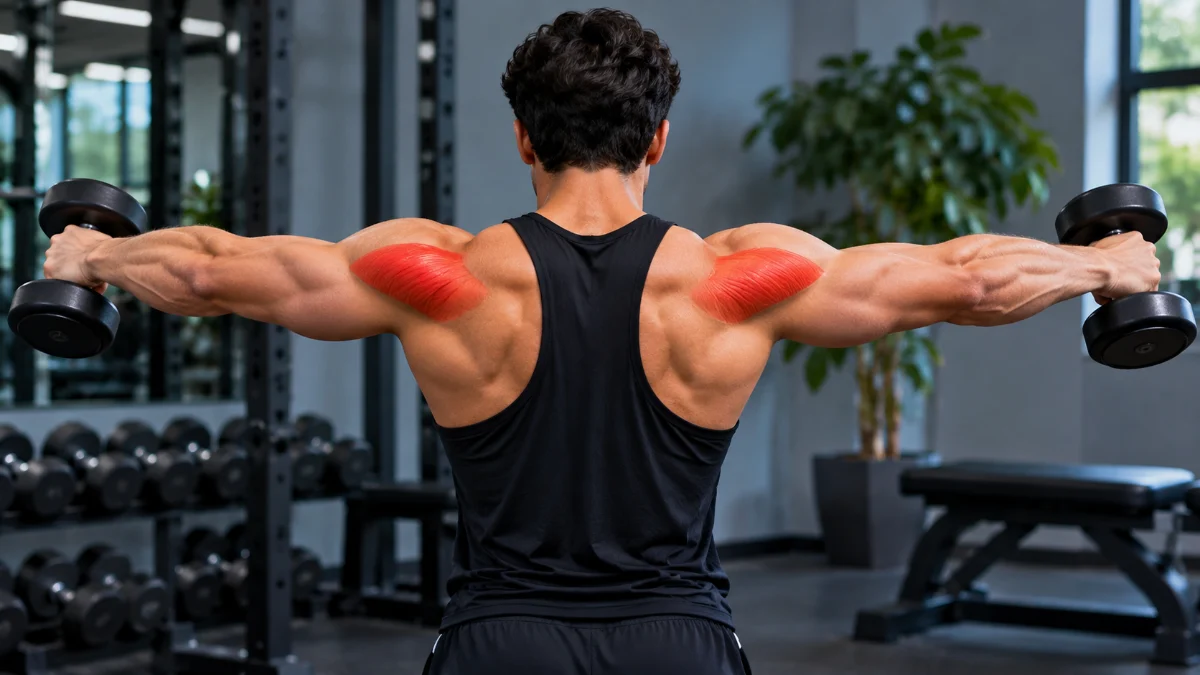
Rear Delt Exercises: Rear delts are the muscles located on the back of each shoulder. They assist with moving your arm backwards and outwards. To develop rear delts, there are several effective exercises you may wish to consider. Some of these exercises include: reverse dumbbell flyes, face pulls, reverse pec deck flyes, cable reverse flyes, and row variations specifically designed to target the rear delts. Each of these exercises will strengthen your posterior deltoids.
These exercises can be performed using either dumbbells, resistance bands, cables, or machines. When beginning to work out, it is generally recommended that you choose two exercises, perform them using controlled reps, and stay consistent with your routine rather than attempting to perform all of the variations of each exercise during a single workout session.
What Are Rear Delts and Why Train Them?
The rear delts are part of the three heads of your deltoid muscles that make up the rear section of the deltoids. The rear delts work with the rest of your shoulder and upper back muscles to help extend your arm behind you (shoulder extension), pull your arm away from your side (horizontal abduction), and rotate your arm outwardly (external rotation).
The emphasis in pressing exercises is placed upon the anterior deltoids, whereas the emphasis in lateral raises is primarily placed upon the medial deltoid. Although rows utilize the posterior shoulder, the utilization of this area will vary depending on both the position of the elbows and the technique used.
Direct rear-shoulder training can help create a better balance of muscles and improve your ability to pull. In addition to creating more visually appealing shoulders, as you build muscle, you will have a more developed look. Although the use of stronger rear delts can help alleviate many of the issues that come with poor posture and potential shoulder injury, they cannot solve all problems related to posture and cannot prevent all types of shoulder injury.
8 Best Rear Delt Exercises for Muscle Growth
These eight movements provide a variety of options regarding the types of equipment you may wish to use and how much resistance you may wish to create. No movement is necessarily better than another. Choose movements that feel right, enable control over the motion, and align with the equipment available to you.
Bent-Over Dumbbell Reverse Fly
Hold a pair of small weights in front of you, with the palm of each hand facing forward. Bend your knees a little, lean forward from the hip joint, and maintain a straight line with your spine.
With slightly bent elbows, raise your arms outward until they reach approximately shoulder level. Gently lower the weights without using any momentum from your upper body.
Begin by performing two or three sets of 10 to 15 reps. When you feel your neck becoming stiff or your shoulders shrugging, decrease the amount of weight used. This particular exercise is ideal for use at home as it takes up very little space and uses minimal equipment.
Cable Rear Delt Fly
Attach two cable handles at approximately shoulder level, using an amount of weight that can be easily managed. If your machine allows you to cross the cables, do so; otherwise, simply stand with both feet firmly on the ground.
Slowly move your arms out to the sides with a slight bend in your elbow. Steady your body and slowly bring your arms back.
Cables give you resistance on most of your movements, but the amount of tension and leverage will change based on how you have your cable machine set up. Try doing two or three sets of 12-15 repetitions.
Reverse Pec Deck Fly
Face the chest pad of the machine and move the handle to about shoulder height. Make sure that you keep your chest supported by the pad and your elbows slightly bent.
Slowly bring your arms back to about shoulder height after moving them out to the side.
This position helps you focus on moving your shoulders by eliminating the need to stabilize your torso. Do not force your arms backward past the plane of your body, and do not use momentum to lift the weights.
Rope Face Pull
Attach a rope to a cable pulley that is approximately eye level. Take hold of each end of the rope and walk backward until you feel the cable become tight.
Move your hands apart and pull towards your face, keeping your elbows bent and slightly raised above your shoulders. Return to the starting position in a controlled manner, without leaning backwards.
Face pulls utilize the posterior deltoid, rhomboid, trapezius, and several additional stabilizing muscles. The NASM face pull guide describes the proper technique for performing this exercise and some of the most frequently made technical errors.
Chest-Supported Rear Delt Raise
Set a variable-angle bench at an approximate angle of about 30 degrees and lie on your stomach (chest-down), holding a pair of dumbbells.
Allow your arms to dangle in a relaxed manner. Slowly lift the weights out to each side of your body, as you keep your chest pressed firmly against the bench, and then slowly lower them back down.
Supporting your upper body will make generating momentum from your lower back much more difficult. When beginning, start with lighter weights than you typically use when performing standard rowing exercises.
Wide-Elbow Dumbbell Row
Place the dumbbells directly below your shoulder line, while leaning forward and resting on the incline bench.
Hold your elbows out to each side, away from your body, but try not to excessively raise your shoulders. After holding for a short period of time, lower.
This variation works both your rear delts and your upper back. In contrast to the traditional close-elbow row, this variation uses a slightly different shoulder motion. You can use whatever elbow angle you find comfortable as opposed to trying to force your elbows into a perfectly flat position.
Resistance Band Pull-Apart
Hold a resistance band at your chest level using both hands. Keep your elbow joints slightly bent, and your shoulders down and relaxed.
Pull the band apart until your arms open comfortably, then return slowly.
Adjusting the resistance can be accomplished by adjusting your hand position on the band or using a different band. This is a very portable exercise that will suit home use, warm-up, and travel. However, with continued use,e you may require a greater amount of resistance to continue progressing.
Single-Arm Cable Reverse Fly
Position yourself laterally relative to a cable machine and hold onto the handle using the hand that is farthest away. Set the height of the cable so it is positioned roughly at the level of your shoulders.
Keep your torso forward and move your arm across and out in a controlled arching motion. Do not twist as you return to the starting position.
Training each arm individually will help you to see the differences in your ability to coordinate and use each arm to its full potential. You can train the same number of reps with each arm;m, however, do not try to move through any pain.
How to Build an Effective Rear Delt Workout
To create an effective workout, you do not need to do all eight of these exercises. By combining one of the direct fly variations with either a face pull or rear-delt-focused rowing exercise, you can incorporate additional movement patterns into your routine while keeping things relatively simple.
| Experience | Exercise Selection | Sets and Reps |
| Beginner | Dumbbell reverse fly and band pull-apart | 2 × 12–15 each |
| Intermediate | Reverse pec deck and face pull | 3 × 10–15 each |
| Advanced | Cable reverse fly and wide-elbow row | 3 × 8–15 each |
Sample start points, not requirements. For beginners who have previously trained the posterior shoulder in some way (i.e., via other back exercises), they may choose to use fewer sets than what is recommended.
Resistance training guidance from the ACSM 2026 recommends that individuals maintain a regular training routine, provide personalized training plans, and work their major muscle groups a minimum of two times per week. As individuals progress in their training, they may need to increase their muscle-building volume based on how well they recover from previous workouts and what type of results they are seeing.
Choosing the Right Weight and Frequency
Select a resistance level where you will find yourself working hard during the last few repetitions, but doesn’t cause you to change the way you perform the exercise. Initially, you should have about one to three repetitions left in reserve.
Rear shoulder training can be done two times a week as long as there is time for recovery from intense workouts. When you feel that an exercise is getting easier to perform, then you should consider adding more repetitions to that particular exercise prior to adding more weight. Be sure to keep track of your workout progress so that you will know when an exercise has become easier to complete.
Common Mistakes That Limit Results
Using too much weight is a common mistake. Heavy weights cause you to swing your arms, decrease the range of motion of your exercise, and transfer some of the muscle work from the target muscle group to other muscle groups.
Another error is lifting your shoulders with each repetition. Use a relaxed neck and a natural, relaxed shoulder position instead of trying to force your shoulders into a rigid position.
Avoid rushing the lowering phase. Control your repetitions to help you stay on track with proper form and make it simpler for you to see how much progress you have made.
Lastly, differentiate between muscle use and pain at the joint. Cease any activity that produces severe pain, numbness, or continuing discomfort. Prior to proceeding with further training, individuals who are recovering from a shoulder injury must receive personalized advice.
- Read more: Rear Delt Exercises
Frequently Asked Questions
Can You Train Rear Delts Every Day?
Daily isolation training is usually unnecessary. Most people can make progress with two weekly sessions while allowing recovery. Light band movements may be tolerable more frequently, but hard training should reflect soreness, total workout volume, and individual recovery.
Are Dumbbells or Cables Better for Rear Delts?
Both can strengthen the posterior shoulders. Dumbbells are affordable and convenient, while cables allow flexible resistance angles. Neither guarantees faster growth. The better option is the one that lets you train consistently with comfortable technique and progressive resistance.
Do Pull-Ups Work the Rear Delts?
Pull-ups primarily train the latissimus dorsi and other pulling muscles. The rear deltoids may contribute, but pull-ups are not a direct substitute for reverse flyes or other targeted movements when posterior shoulder development is your main goal.
How Long Does Rear Delt Growth Take?
Muscle growth develops gradually, and visible changes vary with training history, nutrition, genetics, and consistency. Strength improvements may appear before noticeable size changes. Track your repetitions and resistance over several weeks rather than expecting a fixed transformation date.
Can Beginners Do Rear Delt Exercises at Home?
Yes. Dumbbell reverse flyes and resistance band pull-aparts are practical home options. Begin with manageable resistance, learn the movement, and progress gradually. The ACSM home-training recommendations also recognize bands and home-based strength training as effective approaches.